If you're just landing here, this is Part 2 of a two-part series on vibe coding your own business apps. Part 1 covers FlowSignal, my outreach tracker, and the one piece of advice I ignored to build it so it's worth reading first.
Once FlowSignal was running, I had a second operational Founder Block (im)patiently waiting.
Every week I spend real hours on Substack letters. Then the letter goes out and that's more or less where it ends.

I had a full distribution strategy sitting in a document and I was doing almost none of it because turning one piece into many felt like starting over every time.
The Founder Block here wasn't creativity. It was the conversion step between "letter published" and "content actually distributed."
So the next question was obvious:
1 of 7Could I build something that handled that step for me?
Single Source Of Truth
I know there are different opinions about content repurposing and being present on multiple platforms.
Some of you repurpose a ton of content and publish on every possible channel daily.
Others swear by going all in on one platform.
I'm currently somewhere in between, and what got me thinking was my old mentor's Ryan Levesque concept of becoming the Category of One.
Essentially, what I liked is the approach of having your "Single Source Of Truth" piece - which for me are weekly Substack letters.

And then having a distribution system (Ryan calls it Strategic Content Ecosystem) for all the other platforms.
Just to be clear (if you skipped Ryan's article) - becoming the Category Of One is much more than just having a distribution system. But, distribution is essential part of sharing your unique angle and message wide.
2 of 7Introducing FlowOne
The idea was simple enough to say out loud: paste a Substack link or a raw draft, and get structured content chunks ready for every platform in my distribution system.
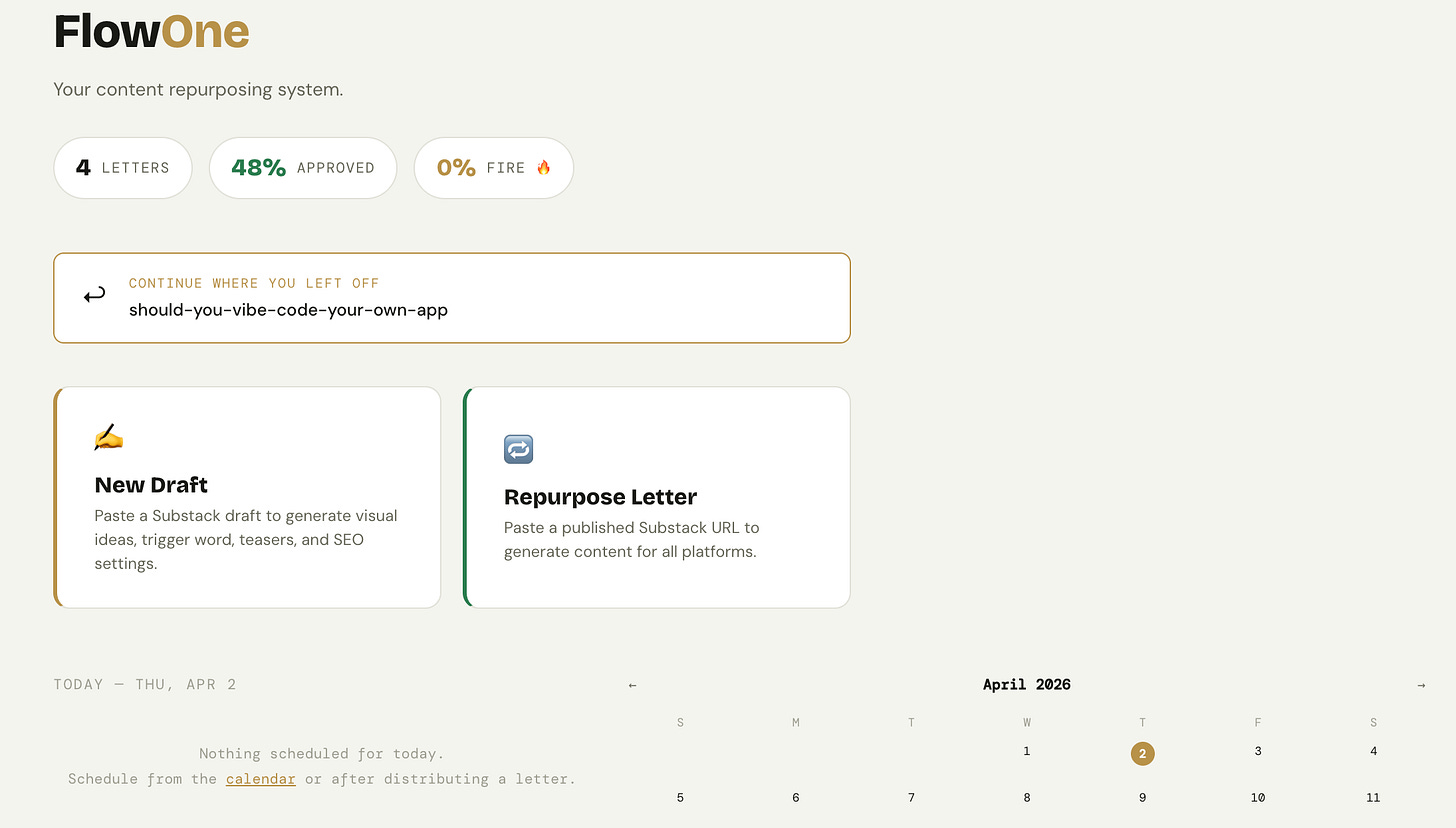
No reformatting by hand or starting from scratch.
What made it more complex was the feedback layer. Without the ability to rate, refine, and teach - I'd just be running fancy prompts in a loop. That's already possible in your regular ChatGPT chats.
So the second question I built around was:
What if each piece of content could be rated, refined, and those learnings carried forward automatically?
It took about five hours to get the first working version live. A few more hours of testing to get it stable.
The biggest new challenge was connecting to the Claude API and making decisions about how sub-agents should actually work together - this was my first time building at that layer.
The setup is the same as FlowSignal:
- Claude Code for the actual programming
- Claude Chat for brainstorming the simplest viable approach
- Claude API to give the sub-agents access to the model's reasoning
Each repurposing run costs around €0.30 and takes 45 to 60 seconds. That's less than a minute to generate roughly 40 content pieces.
3 of 7FlowOne - Draft Mode
This one exists for a specific moment in my workflow that used to create friction every time.
I finish a draft, and I'm not quite ready to hit publish.

There are a few things I still need before the letter goes out: section image ideas, SEO-friendly title and description, and a few Substack note teasers ready to go so I'm not writing those in a rush after publishing.
Draft Mode handles exactly that. Paste your raw draft, and in under a minute I have those elements ready to review. It's not glamorous, but it removed a consistent drag from the publishing process.
(If building something that removes your own version of this friction sounds interesting so far - I've opened two extra slots over the next few weeks where I can help you discover your Founder Block and build a tool to solve it. More info at the bottom.)
4 of 7FlowOne - Repurpose Mode
This is the core of the app.

Once a letter is published, I paste the link and FlowOne pulls the content and runs it through the full distribution system. I can preview how each piece looks on the actual platform - where the text breaks and what needs tightening before it goes into my posting calendar.
If you Zoom in on my screen you can see my repurposing system that covers multiple channels and formats:
- Website blog
- LinkedIn newsletter (plus caption post)
- Carousel slides text (this one is big for me!)
- YouTube (video script, description and thumbnail prompts)
- Substack
- Reels / Shorts (captions and scripts)
…just to name a few (something has to stay behind the scenes and for client eyes only)
5 of 7FlowOne - Brain
The repurposing output impressed me immediately, but the part that actually matters for long-term use is what happens after.

Every piece of content has a feedback field. I can rate it, add notes, and tell the agent what to fix before I lock the letter as finished.
Once a letter is marked complete, every sub-agent records its learnings from that session: what worked, what didn't, and what needed correction.

By FlowOne's own estimate, it takes around 20 finished letters to reach approximately 95% of author-level output. I'm on letter four right now, and the difference from letter one is already visible.
The mechanism here is what separates this from a prompt-based workflow, because this compounds and it's easy to track progress and navigate the learning process.
6 of 7What I'm not showing you
There's a Stats section I'm keeping out of this letter - that one is for clients only.

I needed a way to see which platforms are improving the fastest and where the agents are still making consistent mistakes. It gives an immediate visual of the system getting smarter over time, or occasionally, going in the wrong direction.
There are also a couple of new features in testing: a content calendar and a content library - both aimed at making daily publishing easier to maintain.
The goal for all of it is the same: not to auto-publish, but to have everything ready and reviewed in one place so there's always a human interaction before anything goes live.
That distinction matters to me because faster doesn't have to mean automated.
7 of 7Should you build something like this?
FlowSignal and FlowOne are proving to been real day-to-day helpers and have already saved me a lot of time and nerves on daily basis.
Will I keep building more apps for my business just because I can? No.
I set out to find my two biggest Founder Blocks and see if custom builds could solve them - that's done.
The more important phase now is actually using both tools, improving them through real use, and not letting the building become its own distraction.
The builder-identity piece behind why I keep doing this is in letter 026.
Anything else at this point would just be a shinier version of the same avoidance.
That's why you always have to know exactly which Founder Block you're solving before you write a single line coding prompt.
Want help finding your own Founder Block?
I'm not turning FlowOne into a SaaS product. If your biggest operational drag looks anything like the one I described in sections two and three - the gap between work produced and work distributed - the right next move is usually a conversation, not a build.
The Gameplan is where that conversation happens. It's a 90-minute 1:1 retention diagnostic call, preceded by a guided self-paced FlowOS diagnostic (20-30 min) you complete before we meet, and followed by a written 60-90 day action plan covering the Three Blocks: Momentum, Founder, and Upgrade.
If a custom tool ends up being the right answer for your Founder Block, you'll leave the call knowing exactly what to build and why. If it isn't, you'll save the five hours plus the five years of believing the tool was the missing piece.
-Filip "FlowOne" Sardi

Frequently Asked Questions
What is FlowOne and what does it do?
FlowOne is a custom Substack repurposing app Filip built for himself. Paste a published Substack link or a raw draft, and it returns roughly 40 platform-ready content pieces — LinkedIn newsletter, carousel slide text, Instagram, Facebook, YouTube script, Reels captions, blog post, and more. Each run takes 45–60 seconds and costs about €0.30. It is not a SaaS — it is a personal distribution system built around a Single Source of Truth letter.
How does FlowOne improve over time?
Every piece of generated content has a feedback field. Filip rates it, adds notes, and tells the agent what to fix before locking the letter as finished. Once locked, every sub-agent records its learnings — what worked, what missed, what needed correction. By FlowOne's own estimate, it takes around 20 finished letters to reach approximately 95 percent of author-level output. That compounding learning is what separates it from running prompts in a loop.
How long did it take to build and what was the stack?
About five hours for the first working version, plus a few more hours of testing for stability. Stack: Claude Code for actual programming, Claude Chat for brainstorming the simplest viable approach, and the Claude API to give sub-agents access to the model's reasoning. The biggest new challenge was orchestrating sub-agents — Filip's first build at that layer.
What is a Founder Block and why does it matter before building?
A Founder Block is the specific operational friction that's costing you real hours every week and that you keep avoiding. For FlowOne, it wasn't creativity — it was the conversion step between "letter published" and "content actually distributed." You have to know exactly which Founder Block you're solving before writing a single coding prompt. Otherwise the build itself becomes another form of avoidance.
Should I build my own version of this?
Only if you have a clear Founder Block that a custom tool would actually solve, and only if you'll commit to using it daily once it ships. Filip is intentionally not building more apps just because he can — using and improving the two he has matters more than building a third. Faster doesn't have to mean automated; the goal is everything ready and reviewed in one place, with a human approving before anything goes live.
Client Flow Letter
If this was useful, the next one will be too.
Retention strategy for coaches and founders — every week. No filler.