I love reading, but I read less than I used to.
I also have less patience for long videos unless the topic already has me.
I reach for the AI summaries instead of the source more often than I'd like to admit.
And I get that sweet, satisfying feeling of completion, just because I had a robot do extensive research on a topic while I consumed the final report.
Hi, my name is Filip and I'm your post-AI client.
While we're all making a stand about the importance of human connection, live communities and in-person events, the world around us is also changing forever.
And this isn't a call to arms for or against AI. It's just a reality.
1/ Why "zig when others zag" will hurt many

Need to get this one out of the way first, because of what I'm seeing in the coaching and expert industry, and I believe pure "zigging" will backfire for many seasoned experts.
We are currently seeing one of the biggest shifts of our lifetimes in how people consume and behave as a result of having AI in their corner.
And while I agree with most people making a stand with their "protect human connection before anything else" position, this is a different conversation.
YES, I love working with clients 1on1 and I want to keep even more of that personalized experience when growing my business (heck, that's why I've built FlowOS retention system).
I want to be in more mastermind live rooms, and want more human conversations.
But that doesn't negate the fact that our behavioral patterns are changing permanently because of AI.
So ignoring it and thinking your clients are still acting like it's 2022 will backfire on many.
The middle ground: keep focus on human connection, stay human yourself, and build a client experience for how people actually behave today.
2/ Five traits of a post-AI client
The more I started noticing patterns in my own behavior, the more I got curious about how others experience it across different areas of life. My hypothesis started as:
If I'm doing it, my clients are doing it. If my clients are doing it, yours are too.
Been talking to college professors who are still teaching web design the old way, and categorically refusing to use AI for anything other than to propose the next line of code.
Been talking to psychiatrists about how new patients are arriving with what looks like a shopping list of symptoms, confirmed by three different robots.
Been talking to web designers, coaches, and many others.
My clients are surprising me every week with new things their favorite robot put them up to.
No matter how you turn it or where you look, it's obvious this isn't an AI nerd's bubble.
That's why I've been mapping different patterns that are shaping the most how post-AI clients show up and experience your programs and services.
As you read through each, take a moment and think about how it's affecting your current client delivery. And if you're doing it too - no judgements.
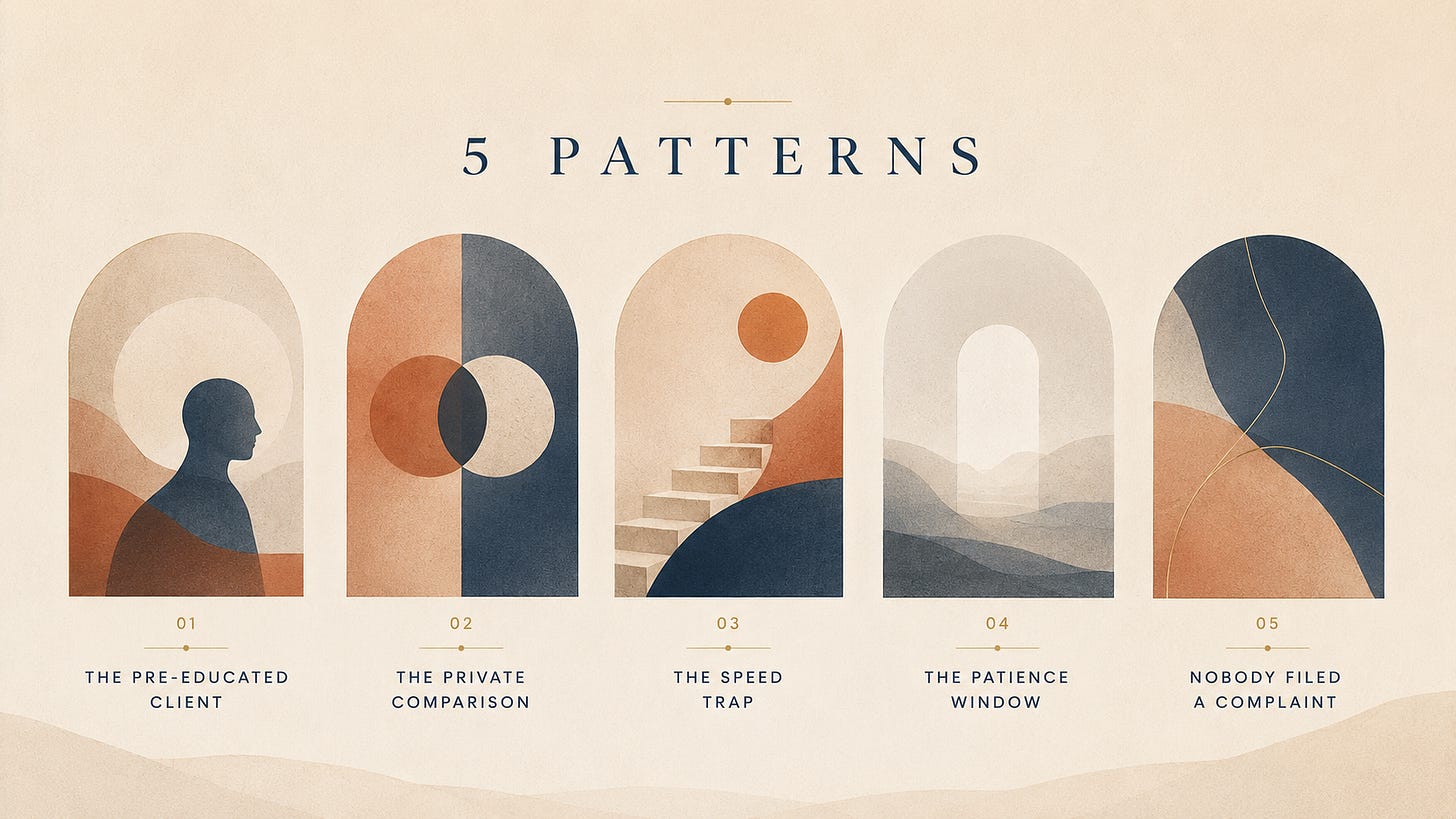
1/ The pre-educated client

I'm noticing this one more and more - clients doing their own diagnostic before the first interaction with you. Forty-five minutes with Claude the night before and they've absorbed the surface layer of your expertise.
Even though they paid you, it can sometimes feel like you have to prove your plan is better than what they already came up with.
Whether it's internal psychological symptoms, launch strategies, or nutrition plans.
A relationship coach I was on a call with last week described her ideal customer to me, and without realizing it she was describing this exact person. "They know so much about everything. They follow the Reels, the TikToks, the private GPT chat conversations. They know what avoidant attachment is, what anxious attachment is. But they don't get why, and they're always stuck in the same spot."
Felt competence is real, while the transformation underneath it hasn't even started yet - and that's a very tricky combination, for both sides.
2/ The private comparison
Between calls, your client is running a detailed comparison.
They asked to be on the hot seat, you gave them a nuanced answer, but that evening they took the same question to AI and got five more options. The robot's answer was cleaner and more appealing, even though yours was more correct.
Even when your client knows you're right (they paid for the experience and the expertise) they'll still reach for a shortcut, and their robot is just waiting to shower them with answers and attention.
They're not questioning your expertise. They've just gotten used to instant gratification and cheerleading.
3/ The speed trap
Which brings me to the most dangerous one.
They suddenly produce so much more content that support elements like "personalized feedback on your materials" are becoming a real problem.
Just last week I had two client situations where they tried presenting copy-pasted generic materials as their own. They were busy, needed to produce some sales copy and pricing packages, and went down the easy route - which ended up sounding like the most generic AI slop. Their robot initially convinced them it was more than good enough.
I don't blame my clients, and you shouldn't blame yours for using AI - but I do need to protect my time and resources as the mentor reviewing their materials.
That's one of the main reasons I've started building both custom AI tools clients can use inside our programs to create high quality assets, and extensive setup instructions for how to use AI when creating assets and strategies on your own.
4/ The patience window
AI reset what "getting help" feels like.
Whatever you deliver in week one now competes against what the same client could have generated alone in an evening. If it doesn't feel meaningfully more than that, the program is on probation before week three.
This is one of the most common blocks I surface in Retention Gameplan diagnostics with coaches and consultants.
Most are still running slow activation and onboarding that stretches for weeks - and they're losing client attention before clients ever get a chance to feel the magic of working together.
That's why the activation milestone matters so much. Making sure clients can get moving and start collecting MicroWins, even when you're not there.
5/ Nobody filed a complaint

This is the one that took me longest to identify.
The pre-AI client would usually say something when things felt wrong - ask for a call or raise a flag. Even when the conversation was uncomfortable, it happened, and you had a chance to fix things before they left.
The post-AI client drifts differently. They don't complain (at least not as much).
Maybe because AI filled the support gap between sessions. Or maybe because they kept producing and somewhere in that "momentum", they started making peace with whatever wasn't working - without telling you.
I've been calling this the Bilateral Trust Collapse and I'll write about it in full soon, because it deserves more than a paragraph.
The short version: the client loses trust in their own progress at roughly the same time you stop seeing the signals that would tell you. Both of you protect a story about how things are going.
What the five have in common
What I kept noticing, sitting with all five of these, is that they're not five separate problems - they're one shift wearing five faces.
The client walking through the door today is running on different software than the one your program was designed for.
They're not a better or worse client. Just a human who's been living with AI long enough that it's changed how they experience time, judgment, and trust.
That's why "zigging" and focusing on human connection and community isn't enough on its own. You have to examine how you currently deliver, and whether it accounts for how client behavior has actually changed.
I help people do this daily. The starting point is The Retention Gameplan - a 90-minute diagnostic where we identify which of the three blocks is breaking your program and map out your first three moves.
Or just send me a message and we'll figure out if I can help.
One small exercise before you go
Think of a client right now whose engagement isn't quite working, but you can't say exactly why. Read the five things above with that client in mind.
If three or more fit, your program or your expertise isn't broken. The post-AI delivery just needs to catch up.
For what it's worth, I've restructured my own delivery twice in the past twelve months. Both times trying to answer the same question:
What do clients actually want, what will they use, and how AI tools can get them faster results without sacrificing quality?
So if nothing else, start there.
-Filip "your post-AI client" Sardi 🌊
PS. Want to map which of the five is breaking your program? or book The Retention Gameplan.

Frequently Asked Questions
What is a post-AI client?
A post-AI client is anyone whose behavior toward expert-led programs changed permanently because they now interact with AI before, during, and after engaging with the work. Same buyer demographic as 18 months ago - different operating system underneath. They arrive pre-educated, run private comparisons against AI, produce more output than judgment can validate, have a shorter patience window, and disengage without filing a complaint.
What are the five post-AI client patterns?
The pre-educated client (arrives with felt competence before transformation has started). The private comparison (runs your answers against AI between calls). The speed trap (produces more material than the mentor can realistically review). The patience window (decides whether the program is working far earlier than before). Nobody filed a complaint (drifts and disengages without ever raising a flag).
How do I know if the post-AI client shift is affecting my program?
Pick a client whose engagement is not quite working but you cannot say exactly why. Read the five patterns with that client in mind. If three or more fit, the program is not broken and the expertise is not broken - the delivery just has not caught up to how the client now behaves.
Does fixing this mean adding more AI to my program?
No. Adding AI features to a program designed for the pre-AI client widens the gap. The shift is in how the client experiences time, judgment, and trust. The fix is examining how delivery is structured - activation speed, feedback load, the moments that require a real human read - not bolting on more automation.
Client Flow Letter
If this was useful, the next one will be too.
Retention strategy for coaches and founders — every week. No filler.