"Hey Filip, sent you my latest campaign emails. Can you please check them out?"
If you've been part of Client Flow for a while, you know I love to write. So when my VIP client asked me to review their materials, I took it seriously.
Two minutes after clicking the Google Doc link, my blood was boiling.
I was looking at a copy/paste of generic ChatGPT output: short sentences, no connection, no personality, no flow.
It was the worst kind of AI output - the kind that technically answers the brief and completely misses the point.
And it wasn't about the quality of the emails alone. It was that this was acceptable to send to their audience.
But instead of biting their head off, I took a different route.
1 of 5
Review the prompt, not the output
I took a deep breath (or ten). Then I gave feedback not on the copy, but on how they were approaching the tool itself. And I suggested they finally make the switch to Claude, because it just dominates when it comes to creative writing.

Twenty minutes later, I got a proud message in our private channel. The new sequence was completely different.
It had a real intro story, a hook that actually landed, personal reflection and a scarcity trigger that came from their own experience rather than a generic template.
But the most important thing - they were proud of it.
The first version had been written tired, behind on tasks, trying to cross something off a list. And I don't blame them. Fifty things on the to-do list, so you pick a tool, generate something, ship it and move on.
The second version took the same amount of time, but the approach was different, and they owned the result.
That's what stayed with me and it was the moment I knew it had to become a full weekly letter.
2 of 5
"AI generates at the speed of compute, but humans assimilate at the speed of biology"
They didn't send that first version because they were lazy or didn't care. They sent it because to them, the task was done.
The words existed on the page, email served its purpose, and that was enough to move on to the next thing.
But what they were actually supposed to be implementing never happened: using their voice through writing and delivering a campaign that builds trust.
The AI generated the output, and somewhere in those twenty minutes, they outsourced the understanding along with the output.
Mia Kiraki 🎭 put it together better than I can in her Substack ROBOTS ATE MY HOMEWORK (make sure subscribe):
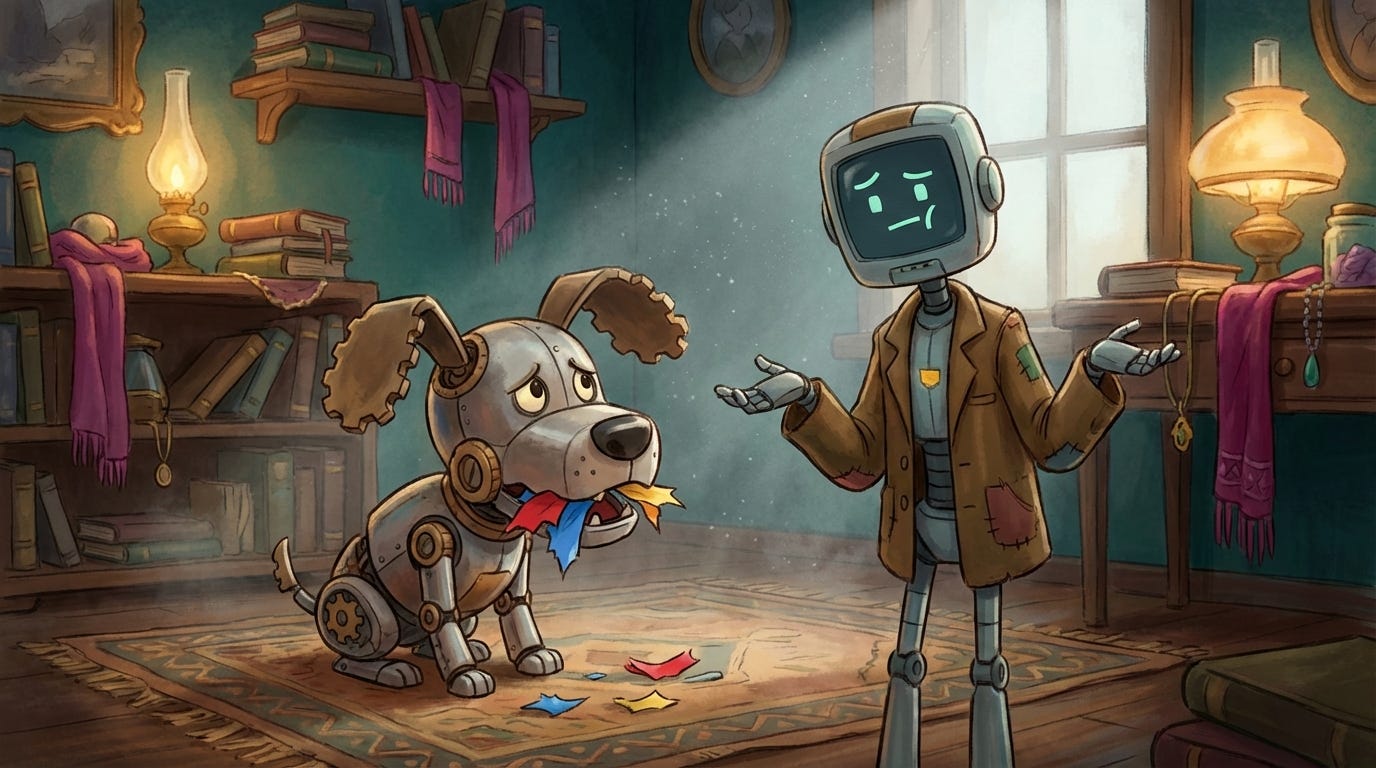
"AI generates at the speed of compute, but humans assimilate at the speed of biology. When a human builds a plan over three hours, the understanding forms during the building. The slow, grinding process of mapping dependencies IS the comprehension. When AI generates the same plan in four seconds, you get the artifact without the understanding. You've outsourced the mapping and accidentally outsourced the comprehension with it."
3 of 5
The implement block didn't disappear - it flipped 180 degrees.

For as long as I've been working with coaches and founders on client delivery (for about 8 years now), the Implement milestone was always the biggest block.
I mapped these three blocks in letter 011 - this letter is what's changed in the Implement block since.
The pattern was consistent across group programs, courses, and mentorships. Clients loved the Educate phase: consuming content, watching videos and building knowledge felt good.
Then the moment arrived to actually do the work: write the copy, build the funnel and implement the launch strategy. That's where everything fell apart.
Because at some point, you have to sit down and do the work. Then you have to ship it to your audience, get feedback and repeat the implementation part until it starts getting results.
Then AI arrived, and I assumed it would easily solve this big block.
Clients could create faster, move through implementation with less friction, produce more in less time. The biggest block I'd been helping clients managing for years would finally shrink.
What I'm seeing instead is a completely different problem.
Clients aren't frozen anymore. They're producing email sequences, strategies, scripts, launch plans in minutes.
The Implement block as I knew it is gone. But what replaced it is harder to see, and in some ways harder to fix.
A friend of mine, a coach working with a client on their 90-day strategy, got on a call to find his client proposing a completely different direction than what they'd built together in their previous session.
The client had used AI to help them with homework, and the AI had generated a polished, confident-looking strategy with no memory of the two hours they'd spent mapping the actual constraints and priorities of that specific business.
When asked why they'd changed everything, the client said: because AI made it sound better. It sounded better. But it had nothing to do with what that person actually needs.
That's the new implementation problem.
The result is output without ownership and speed without comprehension.
And most coaches haven't noticed it yet because on paper, their clients are doing the work.
4 of 5
The real consequence isn't just low quality output
When clients produce more but understand less, something deeper happens over time.

The personality disappears from their work. The voice that made their audience trust them gets replaced by the average of everything the internet has ever said about their topic.
And audiences feel this before they can name it. They don't unsubscribe, but just slowly stop caring. Nothing lands the way it used to.
Here's what makes this particularly hard to manage as the founder of a program: your client thinks they're implementing. You can see they're producing because the volume is there. But the results aren't coming, and neither of you can immediately see why.
That's the new block. Not frozen clients, but busy clients getting worse results the more they produce.
5 of 5
Two scenarios, and where you actually stand
SCENARIO #1: If you don't have AI delivery tools built into your program yet, your clients are already solving this problem without you. They're using ChatGPT or whatever their preferred tool is to get work done faster.
They're producing generic output because most haven't configured it properly and the tool has no idea who they are, what their voice sounds like, or what they've already built with you. You're not seeing it because it looks like implementation.
SCENARIO #2: If you do have AI delivery tools (or you're building them now) the question is whether they're producing work that actually sounds like your clients, or just adding another layer of fast, generic output with your branding on it.
I'm watching a lot of founders scramble to add "AI companions" to their programs right now, and most of what I'm seeing creates more confusion than it solves. The tool exists, the clients use it, and the results are still thin.
The difference comes down to one thing: whether your AI tools know who your client is before they start generating anything.
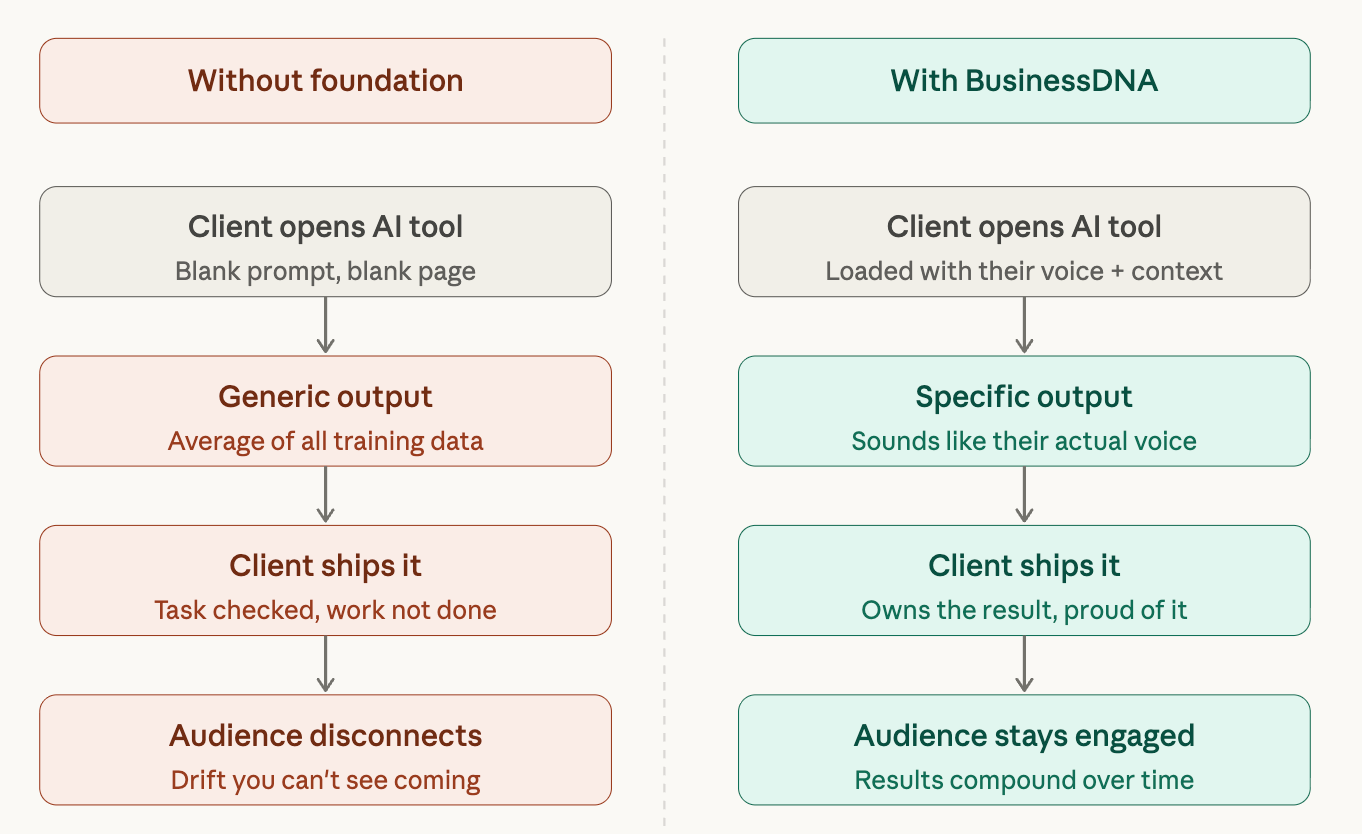
In my case that's BusinessDNA - a five to seven minute onboarding conversation that captures their voice, their offer, their audience, and their communication style.
Every tool inside FlowOS pulls from that foundation.
This is still early. Most founders haven't seen it yet because it doesn't look like a problem, it looks like productivity.
Your job didn't get simpler when AI arrived, it got more specific.
The question is no longer whether your clients will use AI - they already are. The question is whether the tools in your program are set up to make sure that speed works in their favor, not against it.
The Gameplan
If you're trying to figure out where AI delivery tools fit in your program (or whether what you've already built is actually moving the needle) that's exactly what The Gameplan is designed to map.
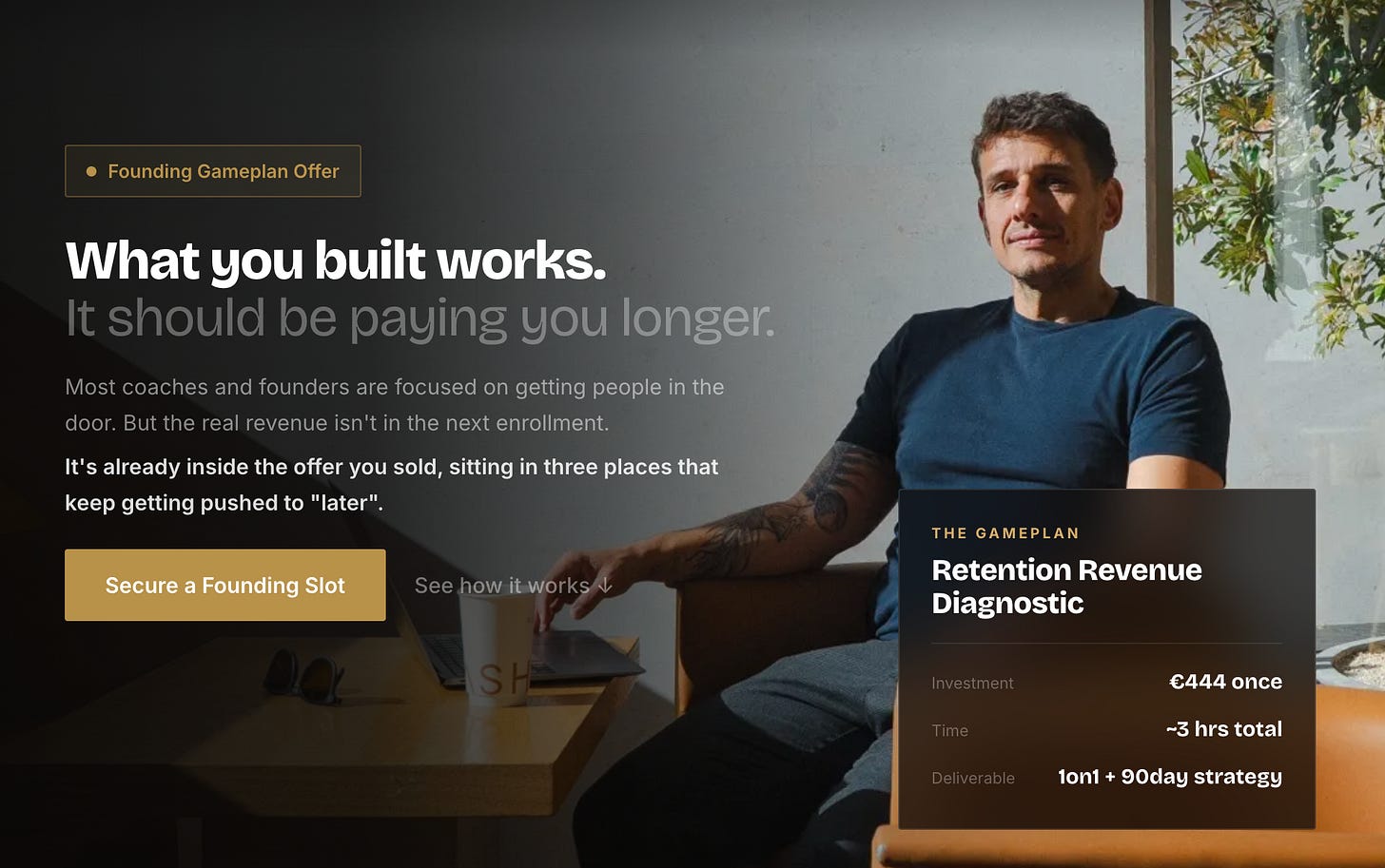
In a focused 90-minute session, we look at your current delivery architecture across all three blocks: Momentum (where clients are building or drifting, including the invisible kind), Founder (where you're stuck inside delivery instead of leading it), and Upgrade (what implementation tools and AI delivery actually make sense for your specific program and audience).
You'll walk away with a written 60-90 day action plan and a guided FlowOS diagnostic completed before the call so we don't waste a minute on context-setting.
and let's see if the Gameplan makes sense for you now.
-Filip "slow down to speed up" Sardi

Frequently Asked Questions
What is the AI speed trap in client delivery?
The AI speed trap is when clients use AI to produce work faster than they can actually understand it. They generate emails, strategies, and launch plans in minutes - but the comprehension that used to form during the slow work of building never happens. The artifact exists, the task feels done, but the actual learning and ownership got skipped. It looks like productivity. It produces worse results.
How has the Implement block changed since AI tools became mainstream?
For years the Implement milestone was the biggest block in client delivery - clients loved consuming content but froze when it was time to do the work. AI didn't shrink that block, it flipped it. Clients aren't frozen anymore, they're producing constantly. But what they produce often has no connection to the strategy you mapped together. The new block is busy clients getting worse results the more they ship.
Why does generic AI output hurt long-term client results?
When clients produce more but understand less, their personality disappears from the work. The voice that made their audience trust them gets replaced by the average of everything the internet has ever said about their topic. Audiences feel this before they can name it. They don't unsubscribe, they just slowly stop caring. Nothing lands the way it used to. The volume is up, the connection is gone.
Should coaches add AI tools to their programs?
Yes - but only if those tools know who the client is before they start generating anything. Most AI companions being added to programs right now create more confusion than they solve because they have no foundation - no voice profile, no offer context, no sense of what the client has already built. The differentiator is whether the tool produces work that sounds like your client, or just adds another layer of fast generic output with your branding on it.
What should a coach do when a client sends generic AI-written work for review?
Don't critique the output. Critique the prompt and the approach. Filip's experience: a VIP client sent a copy/paste of generic ChatGPT campaign emails. Instead of biting their head off about the copy, he gave feedback on how they were using the tool and suggested switching to Claude for creative writing. Twenty minutes later they came back with something they were actually proud of. Same time investment. Completely different ownership.
Client Flow Letter
If this was useful, the next one will be too.
Retention strategy for coaches and founders — every week. No filler.