
A few days ago I posted something on Facebook about a coach friend's reaction to AI in client work. Her take: it feels like betraying a client's trust. Like gossip. Like I'm betraying their trust.
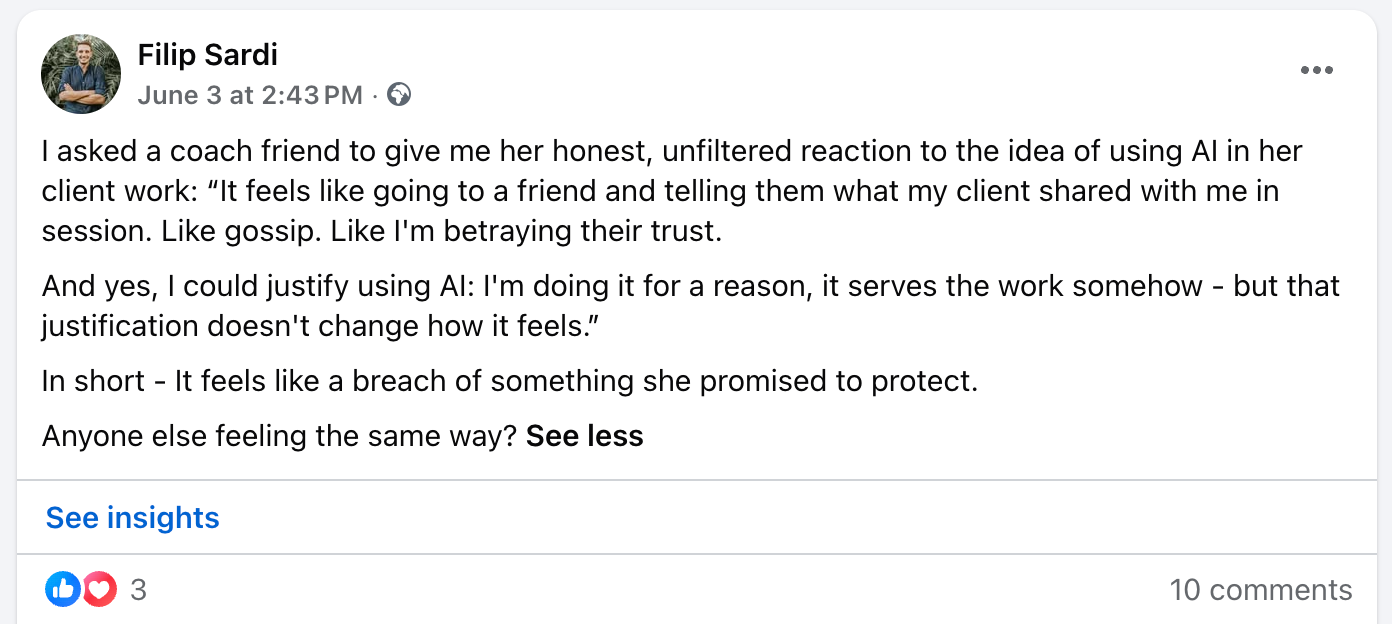
The comments went in different directions fast.
One person called it an idiotic perspective. Another said using AI for client work is like giving a gift you put no thought into - insulting and meaningless.
A third said: "I need more context. How is AI being used in client work? I already use it to summarize session notes so I can focus on listening, but I wouldn't send my client an AI version of me."
That last one comment that made me think.
What if instead of showing how to solve "privacy in AI" concerns, first we need to zoom out and start with bigger questions: what's the problem we're actually solving with AI in client delivery? And are people even aware their challenges can be solved that way?
Because that last comment wasn't against AI. She's already using it, but just hasn't seen what comes after the session summary - and drew a completely reasonable line there.
At the end of the thread I asked one of the coaches: which AI use cases would you actually be ok with?
This is the list for her.
A quick note before the list: none of these are about replacing what happens in the session. Not the conversation, not the relationship or your judgment.
What they address is everything that currently lives only in your memory, your energy, and your notes from three weeks ago - the parts that directly shape how well you show up, and that most coaches are managing entirely alone.
And they are not imaginary items on a "give me 9 implementation examples" prompt, but each is a (mini) feature or a tool I've personally added in my business (FlowOS platform) or for clients.
The list to get you thinking…
1. Capture how your client thinks before you ever meet.
Before the first session, a short AI intake conversation pulls out how they describe their situation in their own words - their language, their metaphors, the specific thing keeping them stuck. You walk into the first session already oriented, not starting from scratch.
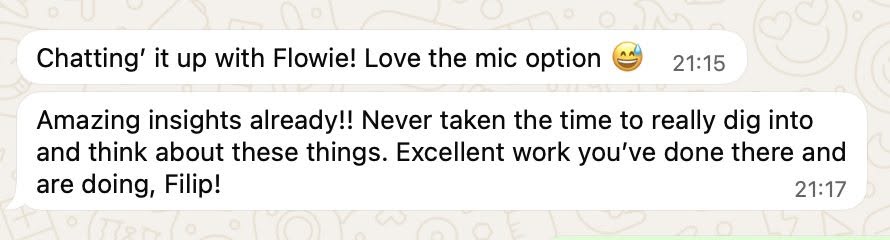
I've applied this one to speed up initial diagnostic and onboarding by hours, and clients love it (and yes, they know they're communicating with my AI strategist - Flowie).
2. Remember what they said three months ago.
That thing they mentioned in week two, the one that connects to what they're circling now? AI holds that thread, which compounds over time especially in longer engagements.
3. Surface the gap between what they said they'd do and what they actually did. Every week there's a commitment. AI tracks the difference between what they planned and what they reported back. You stop relying on memory for accountability and start having deeper conversations about what's actually getting in the way.
I've added a weekly ritual called Client Flow Pulse which helps to reflect progress back to both sides.
4. Tell you who's losing momentum before they go quiet.
A short weekly check-in processed by AI flags who's starting to fade - not after they cancel a session, but weeks before. You reach out at the right moment instead of finding out too late.
This one is more helpful when it comes to performance driven engagements and setting specific goals and milestones.
5. Give your client their own words back to them.
After a session, a short AI-guided reflection helps the client capture the insight in their own language while it's still fresh.
Not your summary of what happened - their version reflected back to them.
6. Spot the pattern your client can't see in themselves.
Three months of check-ins and session notes, read together, often reveal the same theme circling back in different forms. AI surfaces it, and you bring it to the next session as an observation.
That's the kind of moment that makes a client say you know them better than they know themselves.
7. Surface the questions you haven't thought to ask yet.
Before a 1:1 call, AI reads through everything - the notes, the check-ins, the patterns, and flags the thread that hasn't been pulled yet. I had this experience before a client call recently.
The question it surfaced was the one that opened the whole session, and I'd miss it otherwise.
8. Deliver the right part of your program at the right moment.
Not everyone needs module four in week four. Based on where a client actually is right now, AI points to the resource, the exercise or framework that fits their current situation.
Relevance at the right time is the difference between something they use and something they skip.
9. Walk into the renewal conversation knowing the full arc.
It's almost the end of your engagement, AI pulls together where they started, what shifted, what they struggled with, where they grew. You show up with the whole picture and present their real client journey, not just what happened over the past few sessions.
After that, the conversation about what comes next feels like a natural continuation, not a pitch.
None of these sit inside the session. None of them trying to replace the conversation or the judgment that only you can bring.
They help you keep deeper connection even when working with more clients, which was an impossible mission in the past.
One of the reasons why I limited 1:1 work in the past was the fact I just didn't have enough time to keep relationships on such deep level, and I didn't want to sacrifice that connection for gross revenue.
I originally sat down to write a letter about privacy when using client data with AI:
- how to handle client data responsibly
- what the real concerns are
- how to design around them
That letter is still coming, but the Facebook thread and private convos in between made it clear the privacy question is a surface layer.
Underneath it is something coaches hold much closer: the fear of breaking a relationship that only works because it feels completely protected.
The goal of nine examples I've shared is to potentially make your work easier, not to force using AI just because "everyone else is".
So, if none resonate and you still feel like it's crossing the line - I get it, but if any of them sparked the "what if" ideas, let's chat and see if it makes sense to add them to your client delivery flow, together.
-Filip "I'm not your robot" Sardi 🌊
PS. Curious which of the nine would fit your specific delivery? and we'll figure out where to start.

Frequently Asked Questions
What are the 9 AI use cases for client work?
Capture how the client thinks before the first meeting. Remember what they said three months ago. Surface the gap between what they said they'd do and what they actually did. Tell you who's losing momentum before they go quiet. Give the client their own words back to them. Spot the pattern the client cannot see in themselves. Surface the questions you haven't thought to ask yet. Deliver the right part of the program at the right moment. Walk into the renewal conversation knowing the full arc.
Does using AI in client work betray client trust?
Not when AI is used outside the session - on the work that currently lives only in the coach's memory, energy, and old notes. None of the nine use cases replace the conversation, the relationship, or the coach's judgment. They address everything around the session: intake, continuity, accountability, drift detection, pattern recognition, and renewal context.
Should AI be inside the session itself?
No. Every one of the nine use cases is explicitly outside the session. AI handles the work between calls - tracking commitments, surfacing patterns, flagging early disengagement - while the human shows up for the conversation that only a human can have.
What about client data privacy?
Privacy is the surface layer of the concern, not the whole question. The deeper question is whether the relationship still feels protected. The privacy question deserves its own treatment, which is coming. The nine use cases here are designed to address what coaches are trying to do, then privacy can be designed around them.
Client Flow Letter
If this was useful, the next one will be too.
Retention strategy for coaches and founders — every week. No filler.