"Few years ago it would take tens of thousands of euros to build what you can build in a week today."
My business partner told me this yesterday as we were brainstorming the next phase of our new startup.
His sentence stuck with me, and immediately took me down memory lane, through years of my own failures.
Because I've lived the expensive version of that sentence. Literally tens of thousands of euros wasted on half-finished products, with freelancers and dev teams, products that never made it to market for various reasons. Mostly because of my inexperience.
And when I say "building", I'm not talking about the final polished version of a software that's fully market ready, but a simple dirty MVP version where you can test market feedback.
Today, you can have that for 100-200 USD a month of Claude Code subscription.
This is not a piece about vibe coding and the quality of the code, but about what happens now that you can build almost anything you can imagine.
Here's what the past 6 months of building projects in FlowOS Lab have taught me.
1/ Simplify to amplify
The biggest one, to break the ice.
The freedom to build whatever you want is a double-edged sword, because you can just keep adding features and complexity to a product shell no one will probably use.
Been there, done that with my client platform, FlowOS.
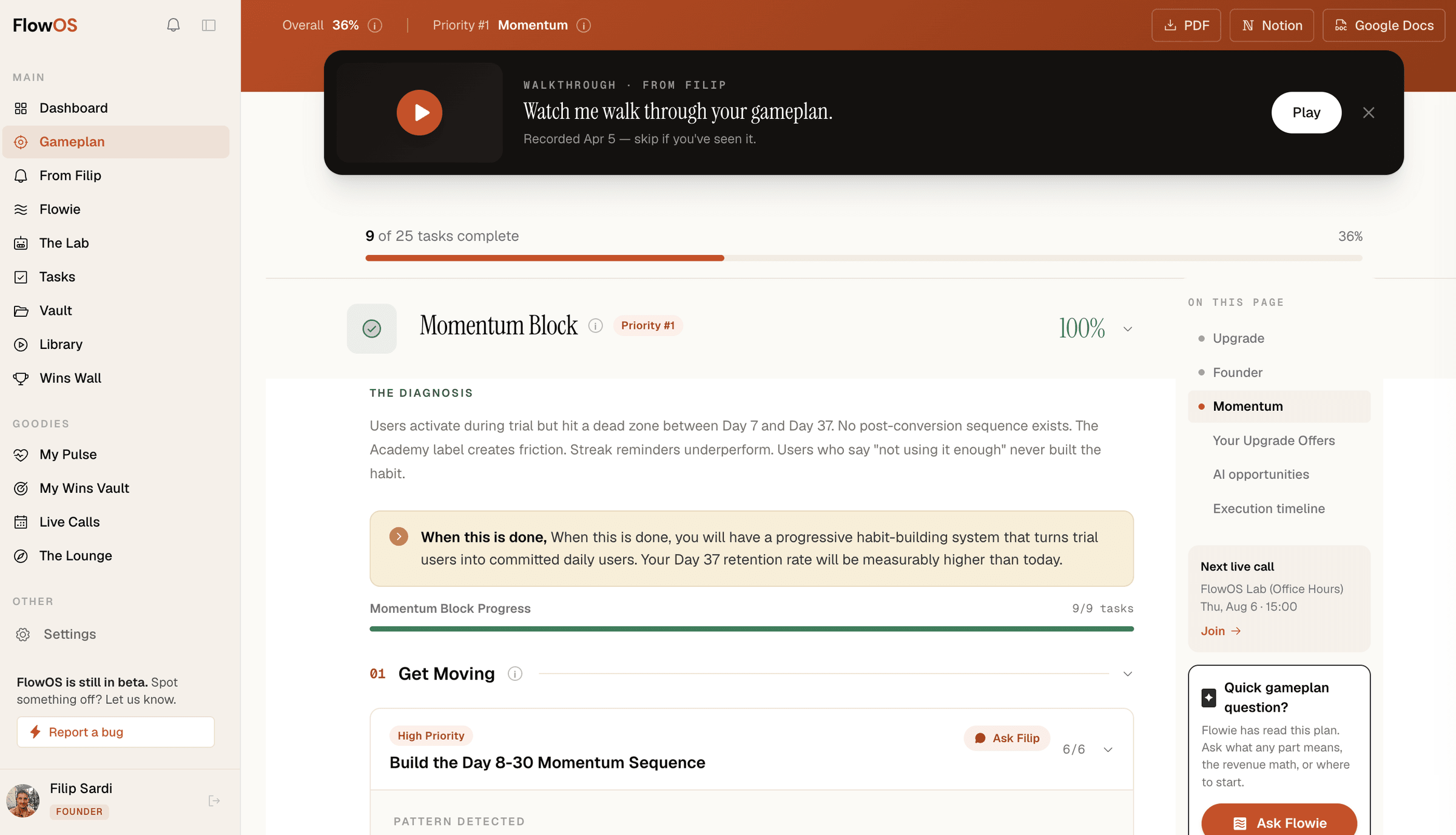
I finally wanted to see what it looks like when every feature I've ever imagined for client delivery works in one place:
- personalized onboarding agents
- a platform that knows everything about its users and personalizes everyone's experience
- document vaults
- live calls and call recordings trackers
- task management systems
- a simplified LMS
- a fully personalized AI strategist for every client
The list goes on.
It's a thing of beauty, but it's not necessary. My client wants to log in and start working on the materials they have for that day.
They want to finish their homework by using an AI Wave (personalized agent), get quality materials and check a task of their list.
That's the whole job.
No matter how beautiful everything is, they don't want to live in the platform, and if they don't have to - not even log in.
So that's what they're getting now in upgraded FlowOS V2: one AI strategist interface that guides them through the day's work, with all the bells and whistles running in the background where they belong.
And instead of trying to change their default behaviour I will make it even more streamlined for them - if they want to, they will be able to do everything from their own Claude Chat.
2/ Build your stuff like Lego
Have you been there too, and built a monster with a bunch of unnecessary features? Don't worry, there's a silver lining.
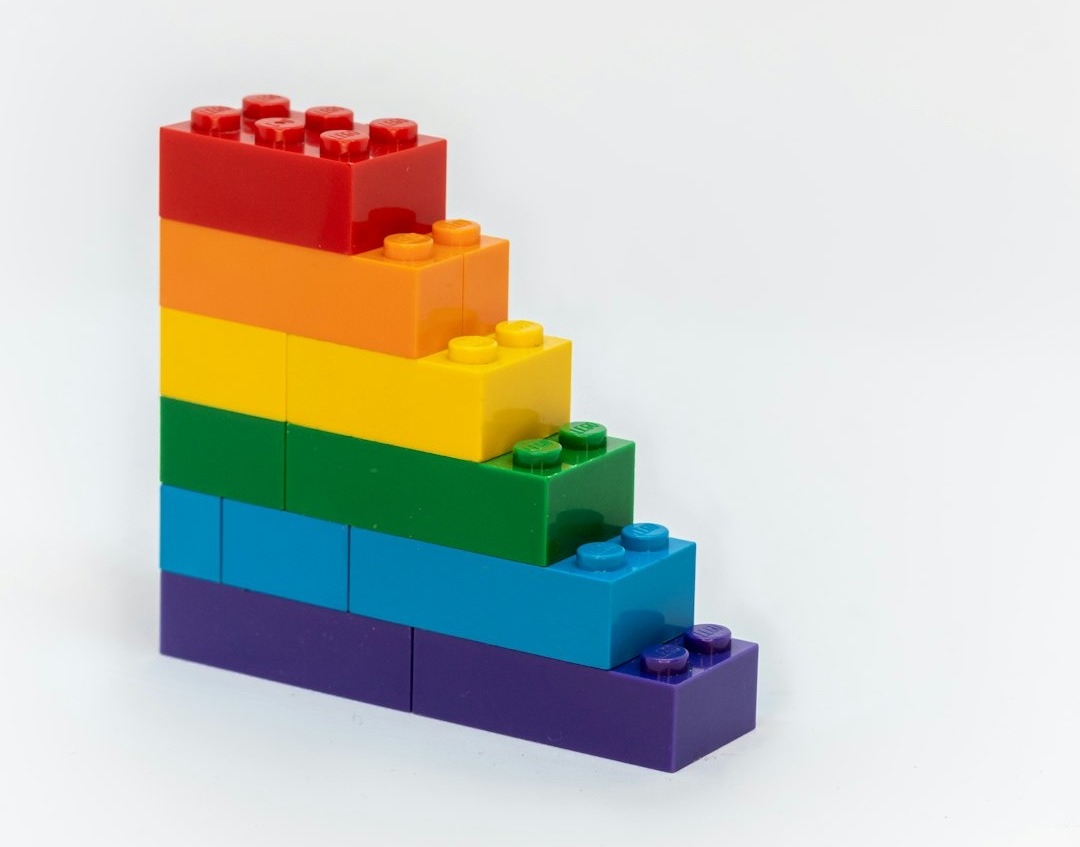
Not sure where I learned this, but from the start of my building days I've focused on having every major feature built as a standalone piece that can be extracted for some other project if needed.
So now, thanks to that monster of a FlowOS platform, I have 10 Lego toys that can easily be added to different projects.
The client progress tracker is now Client Flow Pulse, a standalone app my clients can use with their own clients.
Flowie, the AI strategist, has become virtualX: a standalone engine that builds an AI strategist for any expert, in any niche, one that answers only from material the expert has approved. I wrote about it few days ago here: Claude is coaching your clients behind your back.
Client Flow Score, my client momentum algorithm, is becoming a simple mini app that helps you understand what's really going on with your clients. More on that one in a minute.
And I've reused the core features (tasks, documents, AI strategist) to build a simple project management platform (FlowOS Private) I now use to run all of our projects, including the startup from the first sentence of this letter.
Long story short: build your project like smaller Lego toys on a big playground.
3/ Track AI usage early
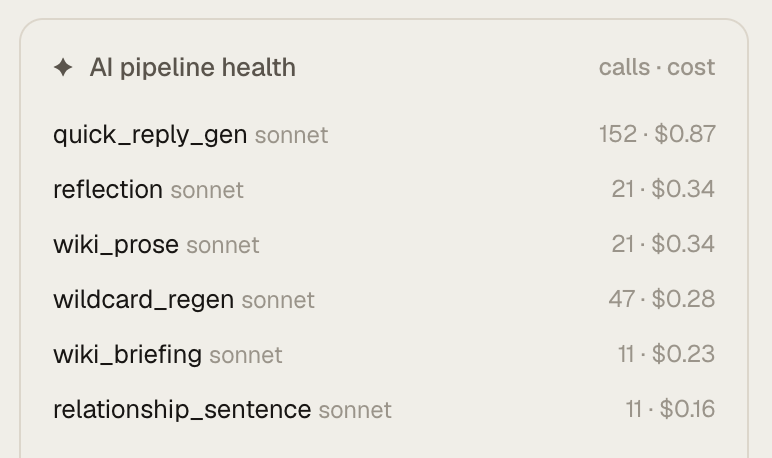
If your project spends tokens, build a mini dashboard that tracks the cost of every single one. Early.
It's all fun and games while you're testing, but what if your project becomes a major success and thousands of people start using it?
You don't want to end up with a successful project and 0% or skinny profit margins, just because you didn't account for what the tokens will cost you at scale. Plus, your AI bill will only grow with time (it will), because tokens will get more expensive.
I learned this on one of my live apps. My first napkin estimate said each active user connection would cost me around $0.25 a month in tokens. Then I measured real usage: $0.41. That is a major difference at scale.
Having this for any AI-powered project takes literally one proper coding session with your favorite robot.
4/ Dream big by thinking small

You don't have to build an AI-powered space station just because you think you can.
I recently had a long overdue catch-up chat with a friend who's selling a simple tool with a simple promise: regulate your nervous system in 7 minutes.
That's exactly what we'd package as a low-ticket front end offer in the past, as a PDF or a mini course. But now it can live as an interactive app instead.
He inspired me to dream big by thinking small, and soon I'll test my first such app with a cold audience to see how people respond.
A simple scan with a simple promise:
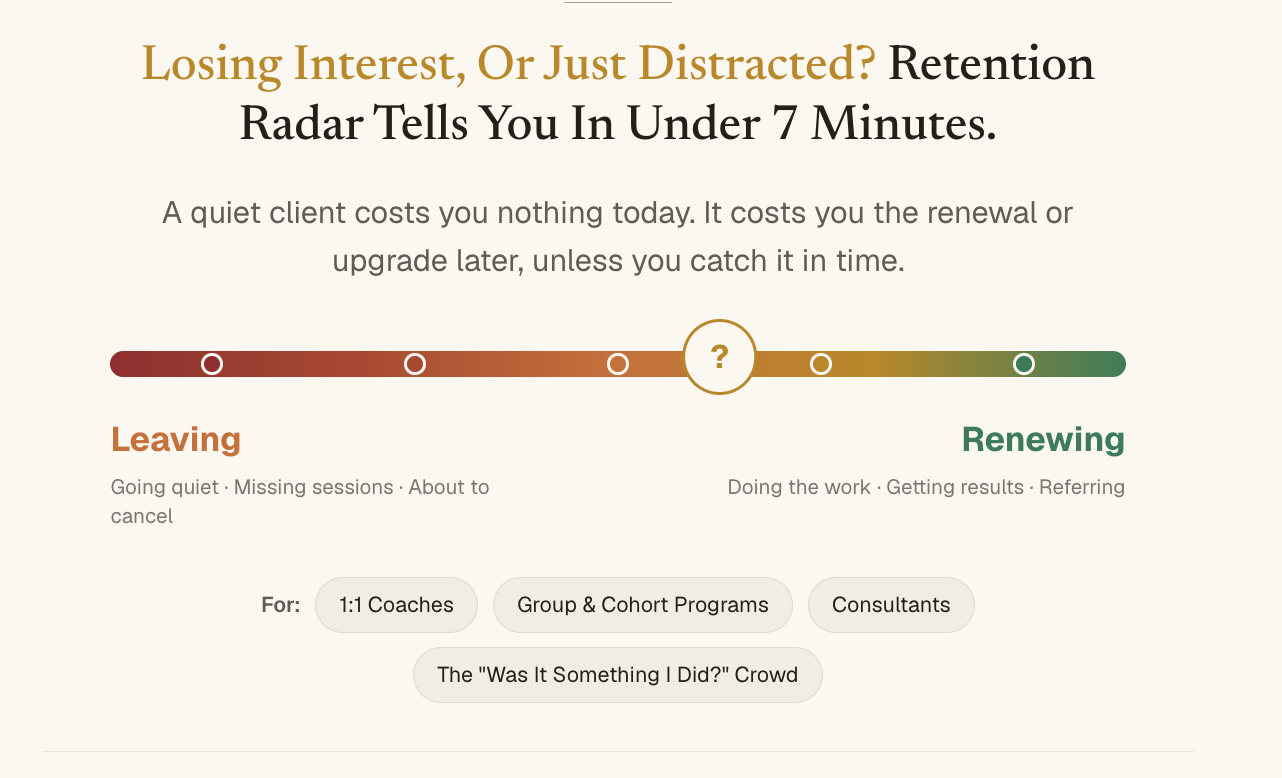
Is your quiet client losing interest, or just distracted? You'll know in under 7 minutes.
It's called Retention Radar, and we'll soon se what people have to say about it.
5/ Have fun
You don't have to build only business-related projects, or expect a major success from every experiment.
The project I'm having the most fun with has nothing to do with business, and I build on it when I need to take time off.
It's live, and there were no big public launches or announcements (for now).
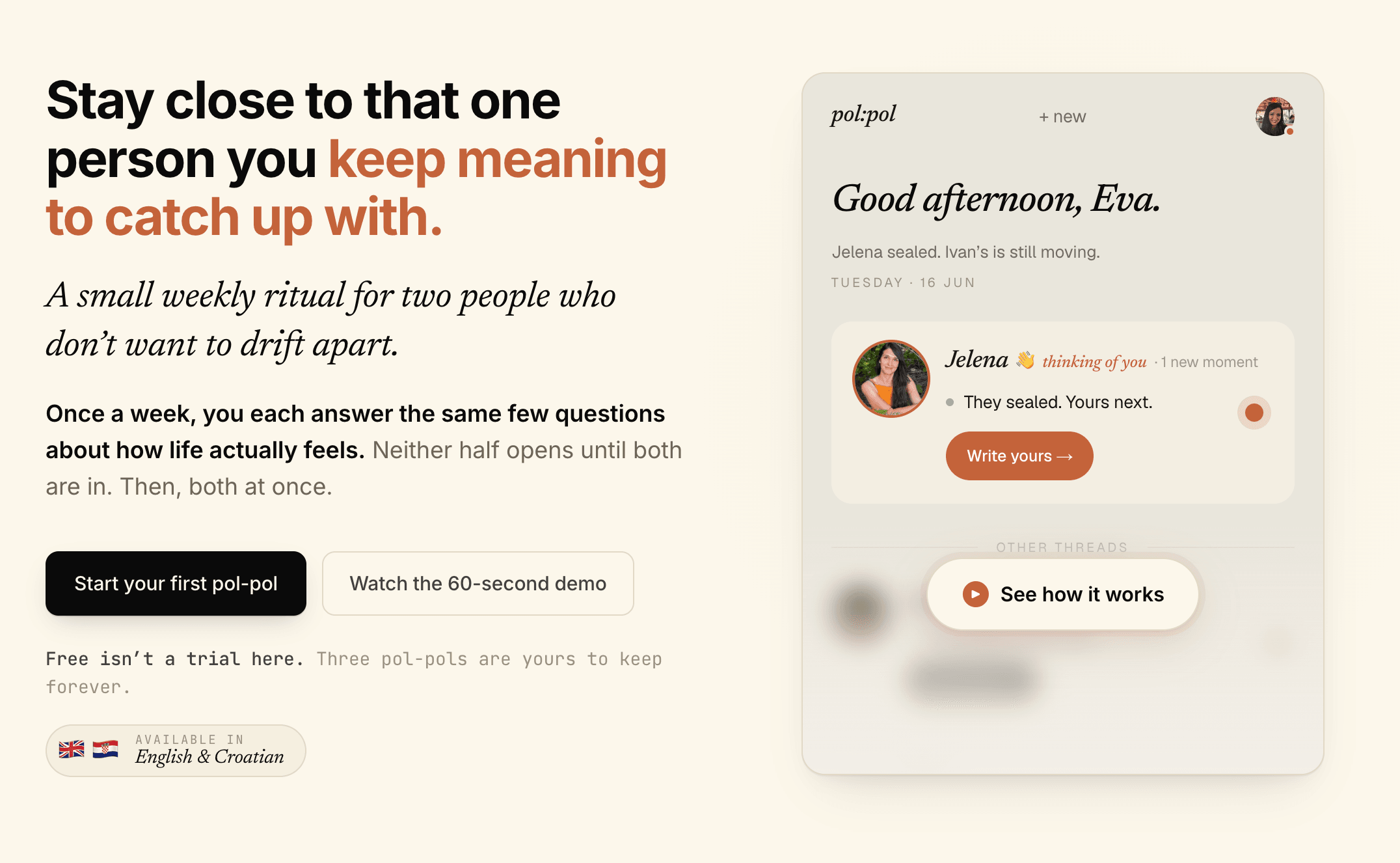
It's called pol:pol, and it keeps people from drifting apart while capturing moments of their relationships.
I wanted to stay closer to my sisters.
I wanted to hear what's up with my friends more often, the ones who, like me, don't like to blabber on the phone for hours.
The first reaction is usually the same: "yeah, but we have WhatsApp for that."
Yeah, right. Then why is it not working? Why is there still at least one person you'd like to hear from more often?
So I built a solution, which is now used daily by people I don't even know.

How fun is that?
And if it becomes something millions of people around the globe use to stay connected to their loved ones, even better.
People ask me: Filip, why do you work all the time?
And I respond: why do you play your Nintendo Switch or PlayStation?
(btw - I don't work all the time and there's a photo of me seen in the wild to prove it :D)

Most of these projects are fun games for me. Instead of figuring out levels and defeating big bosses, I'm figuring out ways to connect the dots and bring my ideas and visions to life.
The next level is already loading.
-Filip "still playing" Sardi
PS. My main focus is still helping you navigate the post-AI client world better and help design ways to make sure your clients keep trusting you, even when all the "answers" are just one prompt away.
The easiest way to start is by doing a Retention Gameplan diagnostic for your flagship offer and see how AI supported delivery fits with your existing client experience. or reply for more details.

Frequently Asked Questions
How much does it cost to build an MVP with Claude Code?
Around 100-200 USD a month for a Claude Code subscription. That covers a simple, rough MVP you can put in front of a market to test feedback, not a polished production product. Filip Sardi spent tens of thousands of euros on freelancers and dev teams on earlier attempts, most of which never reached market. The economics of testing an idea changed completely.
What is the biggest mistake when you can build anything?
Building everything. The freedom to add any feature you imagine leads to a product shell nobody uses. Filip built a full client delivery platform with onboarding agents, document vaults, call trackers, task management, an LMS and a per-client AI strategist. Clients did not want to live in it. They wanted to log in, do the day's work, and leave. The rebuild reduced it to one AI strategist interface with everything else running in the background.
Why should you build software features like Lego pieces?
Because a feature built as a standalone piece can be extracted into another project later. One over-built platform produced ten reusable components: the client progress tracker became Client Flow Pulse, the AI strategist became virtualX, the momentum algorithm is becoming a mini app, and the core tasks and documents layer became a separate project management platform. Nothing was wasted.
Why track AI token costs early in a project?
Because a napkin estimate is usually wrong and the error compounds at scale. Filip estimated $0.25 per active user connection per month on one live app. Real measured usage came in at $0.41, a 64% miss. If a project succeeds with thousands of users, an unmeasured token bill turns a good product into a thin-margin one. Building a cost dashboard takes roughly one coding session.
Does every project need to be a business project?
No. The project Filip has the most fun with has nothing to do with business. pol:pol is a weekly ritual that keeps people from drifting apart, built during time off, launched with no announcement, and now used daily by people he has never met. Not every experiment needs to justify itself commercially to be worth building.
Client Flow Letter
If this was useful, the next one will be too.
Retention strategy for coaches and founders — every week. No filler.