The client calls are personal. Moments between the calls usually aren't.
That gap is what most coaches and founders don't examine closely - the space where clients are working alone and deciding what to do next - either building momentum or losing it.
On the call you adapt to them instinctively. Off the call, they're navigating the same fixed experience as everyone else.
I've been trying to close that gap properly for years. The last few months are the closest I've gotten.
When most people hear "personalization", they think first name in an email. Or letting someone choose between Module A and Module B. Or an AI companion that answers FAQs about course content or framework.
Real personalization means the experience itself changes based on who the person is, where they actually are in their journey, and what they're actually dealing with - not where your curriculum assumes they should be.
Until recently, building something like that required either a dev team or a serious tolerance for disappointment (been there many times).
(If what you are about to read resonates - and let's see how we can model true personalization in your offers and programs)
1 of 5Before the first 1:1 strategy call
When someone starts working with me, the first thing they do is have a conversation with an AI diagnostic agent I built called BusinessDNA. It asks about their offer, pricing, audience, delivery model and it adapts based on what they say. Someone running a consulting offer gets different follow-up questions than someone selling a cohort program.
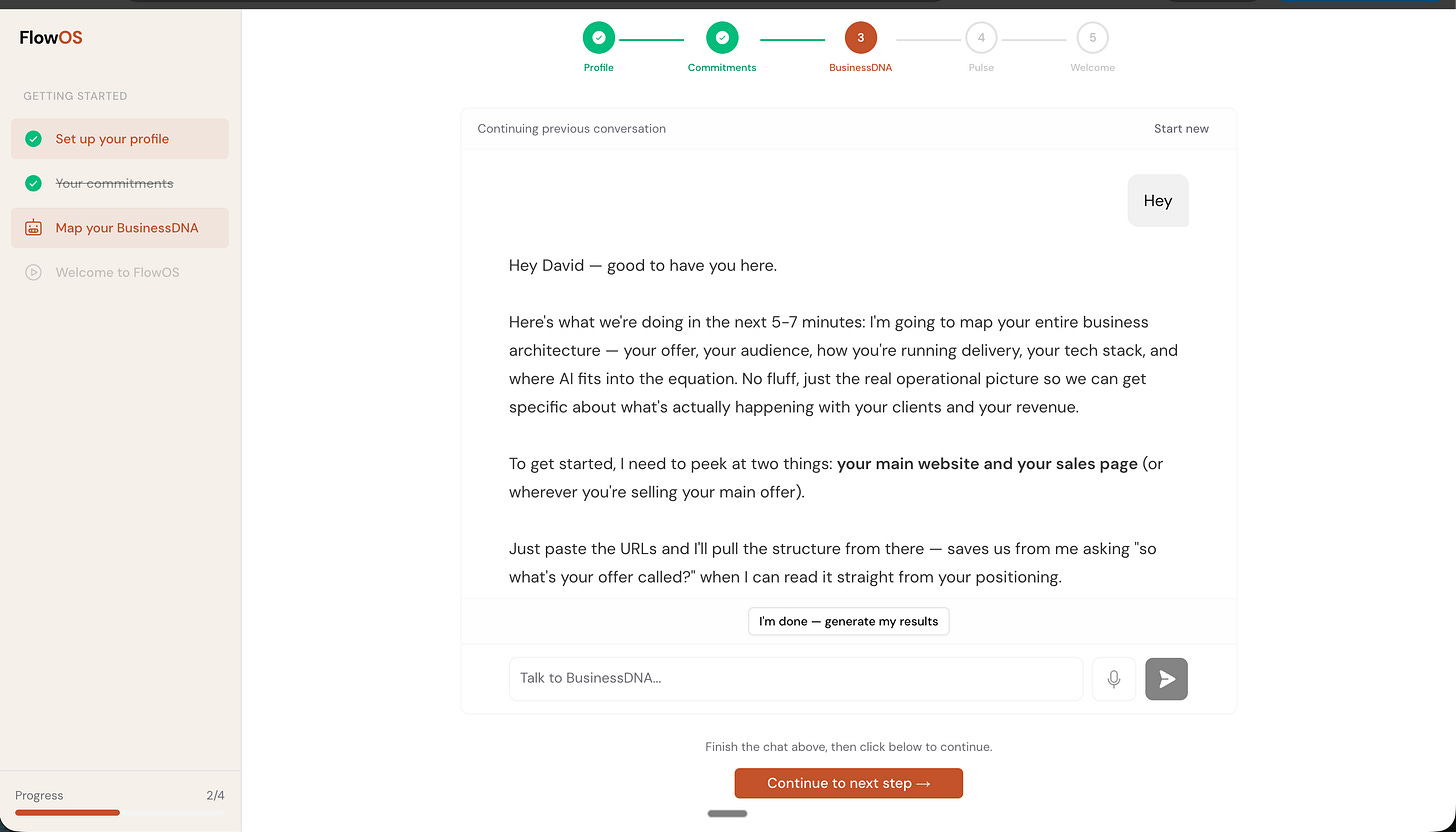
The part people don't expect is what happens when the diagnostic catches something. In a recent session, a client mentioned her clients "freeze a bit" after the first strategy call. The system didn't move on. It said:
"That 'freeze' moment is interesting. What does it look like in practice?"
She stopped and responded: "They show up but want to do three things at the same time. They can produce fast because they have AI tools to help."
Suddenly we weren't talking about a generic onboarding problem. We were looking at the real pattern: scattered momentum, not disappearance. That one follow-up question changed the diagnostic flow and my understanding of her real challenge.
Then they go through FlowMapper, which maps their actual client journey. Where do clients enter? What happens in week one? Where does momentum typically drop? Where do people go quiet?
The diagnostic doesn't just collect data - it identifies patterns in real time. Midway through one session, the system said: "So the risk isn't disappearance - it's scattered momentum."
The client paused and said: "Yes. Exactly that." She'd been calling it "low engagement" for months, but it wasn't low - it was unfocused. That reframe changed how she thought about the fix.
And by the time we get on our first 1:1 strategy call, the patterns already have names. We're not discovering the problem. We're designing the fix.
2 of 5The delivery layer
There are two outputs from every client diagnostic process.
The client sees a clean summary: here's what I mapped, here's what happens next.
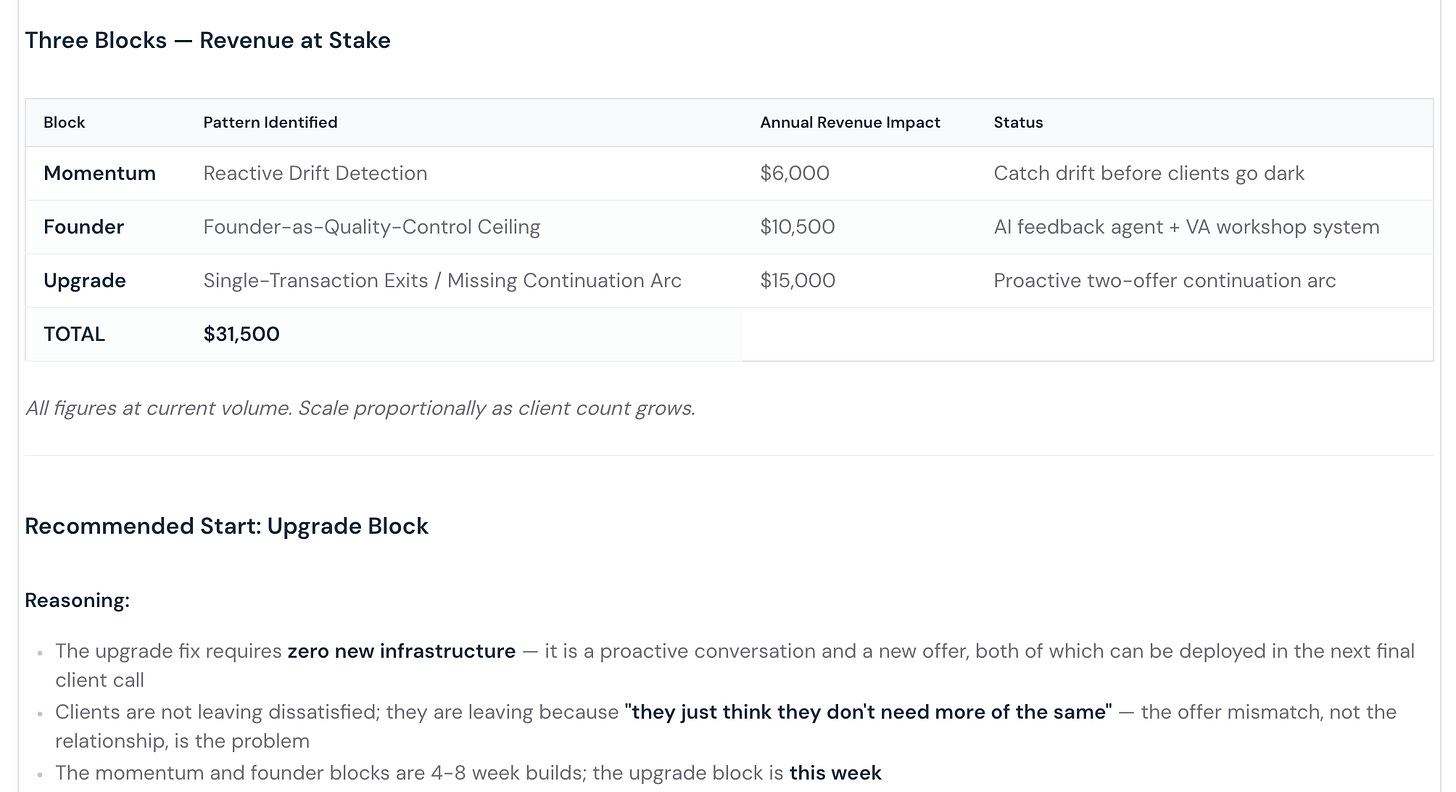
I see a forensic breakdown - verbatim quotes, timeline observations, detection keywords, conversation flow analysis, consultant prep notes.
The client doesn't need to know I have a 3,000-word case study of their retention architecture sitting in my dashboard. They just need to feel heard.
That separation, warm summary for them and forensic detail for me, took weeks to get right. But it's what makes the experience feel personal instead of clinical.
The client doesn't receive a PDF or Google Doc.
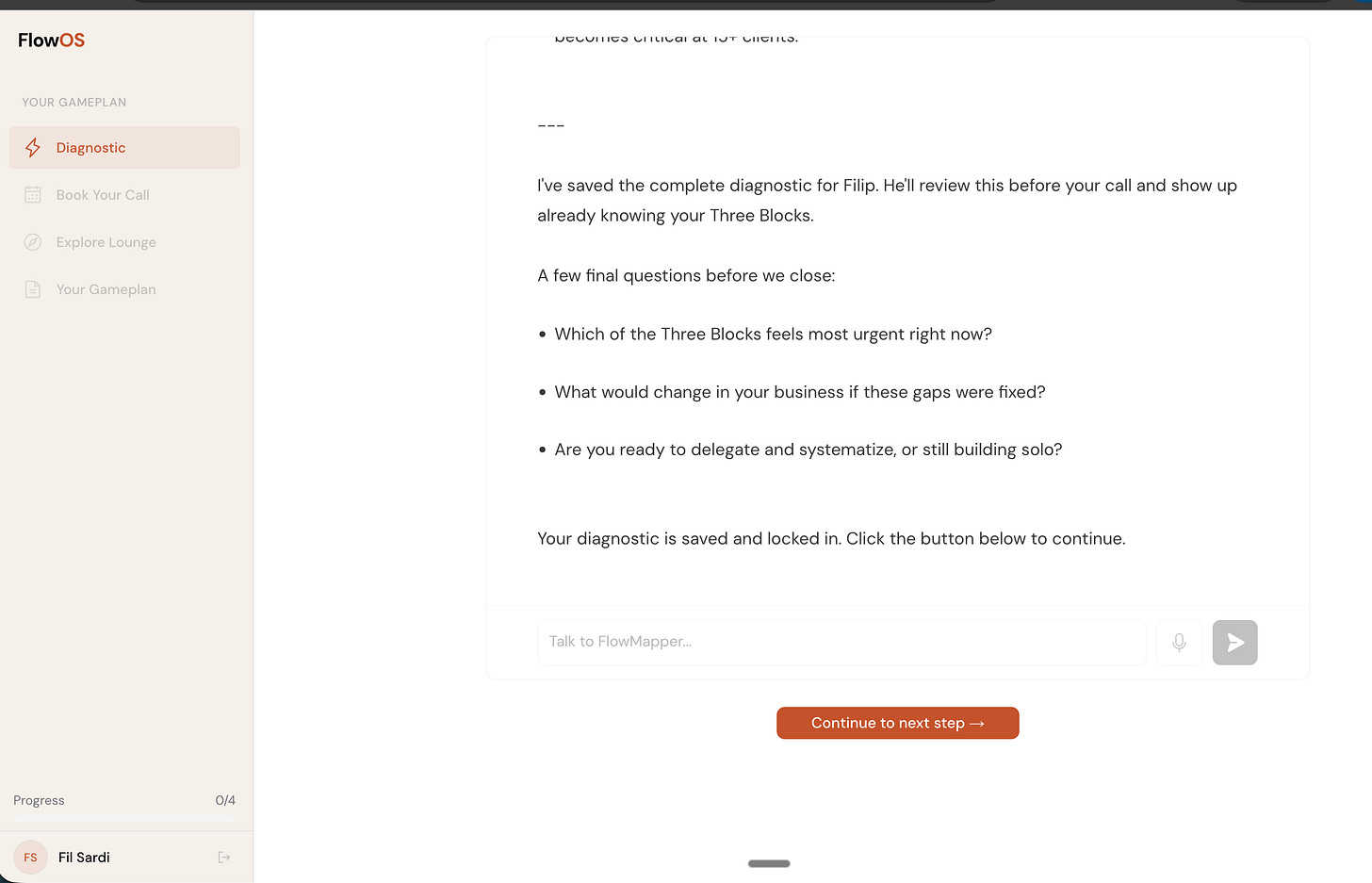
They log into a platform where their gameplan lives - interactive, with their specific blocks, their specific actions, their specific numbers. They can check off tasks, track progress, and see how far they've come.

(want to get your own Retention Gameplan? Start here and let's chat)
Finally, sitting at the top of their dashboard is an AI strategist I named Flowie (don't judge me) that has read their entire diagnostic, their business model, their gameplan, and their current progress.

When a client logs in on a Tuesday morning, Flowie might say: "Your Momentum Block is 67% implemented, but the onboarding sequence hasn't moved in nine days. That's your biggest lever right now - want to unblock it?"
I broke these blocks down in letter 011.
It's not a chatbot answering FAQs. It knows this person's situation and speaks to it specifically. It knows their numbers, their stuck points, what they said in their diagnostic three weeks ago.
When someone goes quiet for a week, Flowie notices. When someone completes a big milestone, Flowie connects it to the bigger picture. When someone keeps picking up the easy tasks and circling around the hard one, Flowie names the pattern.
Warmly and without judgement, but pointing to what matters underneath.
3 of 5What it actually costs
And now the part most people assume is expensive: running AI diagnostics at scale. After one recent diagnostic:
- 25-minute conversation
- 46 messages exchanged
- 10 minutes of voice input (client spoke their answers instead of typing)
- Complete forensic breakdown generated
- Total cost: $0.91
Not $9.10. Ninety-one cents.
For context: the diagnostic replaced what used to be a 60-minute intake call where I asked questions, took notes, and spent another 30-60 minutes writing up a strategy brief afterward.
That's 90-120 minutes of my time at consultant rates: call it €500-€700 in opportunity cost, replaced by a system that costs less than a coffee.
The shift isn't "AI is cheap so use it everywhere".
It's "the things that used to require your time and attention can now run at near-zero marginal cost - which means you can focus your hours on the work that actually needs you."
I'm not building this because I want to replace myself. I'm building it because I want to reserve myself for the parts of the work that matter.
4 of 5AI is the engine, not the steering wheel
I'm sharing all of this not to show off what I built (okay, maybe a little - this development period was intense).
I'm not telling you to replace your courses with AI. I'm saying to use AI to make your methodology feel like it was built for each specific person going through it.
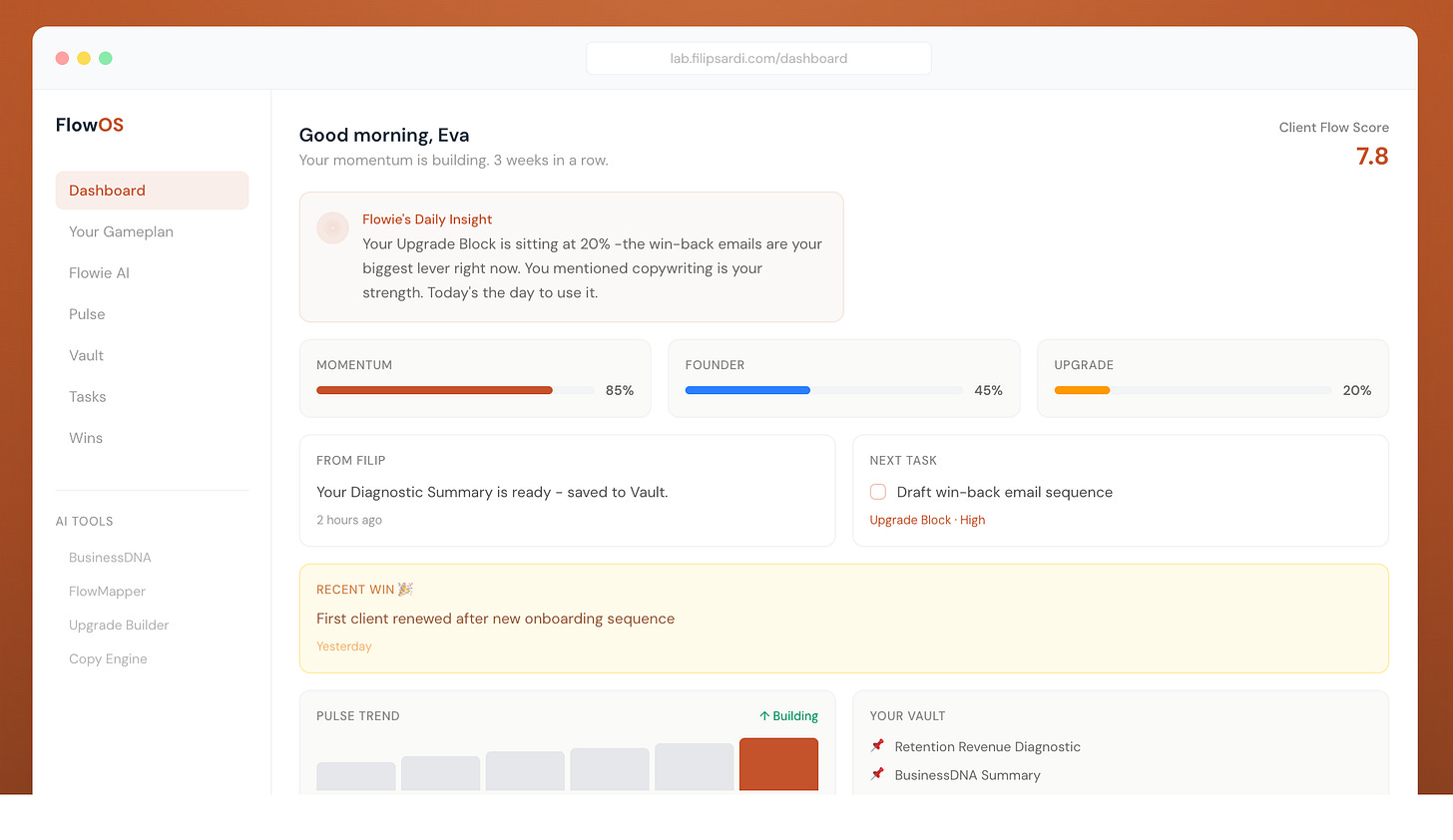
The courses, the frameworks, the modules - they all stay. They're your intellectual property. Think of them as the steering wheel. AI is what makes them feel personal at scale.
(I made the steering-wheel argument first in letter 008.)
When I sit down to build their strategy, I'm not starting from scratch. The diagnostic data flows into a builder where AI pre-fills a big chunk of the gameplan - the three retention blocks, revenue calculations and priority order.
I review it, adjust it and add my judgment. But the heavy lifting of turning raw diagnostic input into a structured plan happens in minutes, not hours.
5 of 5What changes when delivery feels personal
Every week, the client has a short check-in - not a form, but a 1-2 minute conversation. It tracks how they're feeling, what's moving and what's blocking. Over time it builds a Client Flow Score: a running read of where their momentum actually is, not where you hope it is.
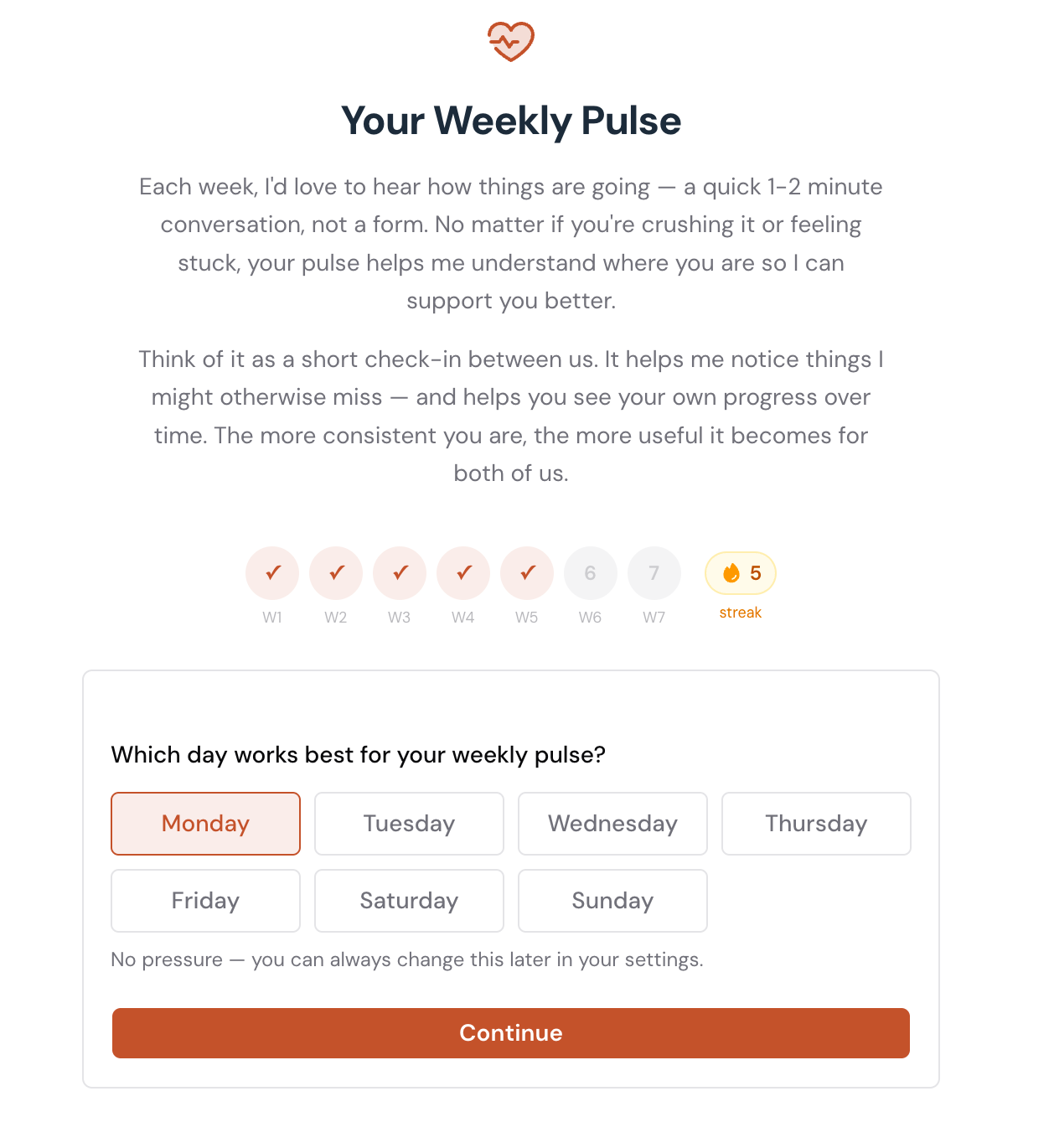
That's what Flowie draws on when it shows up on Tuesday morning knowing the onboarding sequence hasn't moved in nine days.
And here's what happens when all the signals I mentioned so far start compounding:
Clients move faster. They can see exactly where they are and exactly what's next, and that visibility alone removes most of the "I don't know what to do" paralysis.
They ask better questions. When someone has their specific data in front of them, they stop asking "what should I do in general?" and start asking "should I fix the onboarding gap first or the feedback loop?" That's an implementation question and that's where actual progress happens.
They stay engaged longer. The experience feels like it was built for them - it knows their business, their patterns, their progress. It's the opposite of a PDF (no matter how great the content is) sitting in a downloads folder.
I don't think every coach or consultant needs to build a custom platform. That's my particular obsession, and I happen to enjoy the building part perhaps a little too much.
The question worth sitting with is this:
What would it feel like for your client if the experience of working with you adapted to who they are - not just on the calls, where you naturally do this anyway, but in everything between the calls?
The space between calls is where most of delivery actually lives. And for most of us right now, that space is generic. Same modules. Same pace. Same "how's it going?" check-in.
Real personalization isn't first-name tokens in an email. It's the system knowing that this person's Momentum Block is 67% done but their onboarding sequence hasn't moved in nine days - and saying so.
It's the diagnostic catching the word "freeze" and asking what it looks like in practice. It's the gameplan showing €24,000 in the waiting room gap - not "you should probably fix retention."
The tools to build this exist now. Not in six months.
So, you may want to start building personalized delivery before it becomes the baseline expectation.
-Filip "and Flowie" Sardi
PS. This letter got you thinking about adding personalization to your client experience? Let's chat on the Gameplan call and see how to make it happen. Perfect starting point would be to get your own Retention Gameplan mapped out.

Frequently Asked Questions
What does true personalization in client delivery actually mean?
Real personalization is not first-name tokens in an email or letting clients pick Module A vs Module B. It means the experience itself changes based on who the person is, where they actually are in their journey, and what they are dealing with right now - not where your curriculum assumes they should be. The system knows their numbers, their stuck points, what they said weeks ago, and adapts to them between calls, not just on them.
How does an AI diagnostic differ from a generic intake form?
A generic intake collects answers and moves on. An AI diagnostic catches signal mid-conversation. When a client says her clients "freeze" after the strategy call, the system pauses and asks what that looks like in practice - and a generic onboarding question becomes a real pattern: scattered momentum, not disappearance. By the time you get on the 1:1 call, the patterns already have names. You are not discovering the problem. You are designing the fix.
How much does it cost to run an AI diagnostic for a client?
A recent 25-minute diagnostic with 46 messages exchanged and 10 minutes of voice input cost $0.91 total - including a complete forensic breakdown. That replaced a 60-minute intake call plus 30-60 minutes of writeup time, roughly €500-€700 in opportunity cost at consultant rates. The shift is not "AI is cheap so use it everywhere" - it is "the things that used to require your time and attention can now run at near-zero marginal cost."
Does AI replace the coach or the methodology?
Neither. The courses, frameworks, and modules stay - they are your IP, the steering wheel. AI is the engine that makes them feel built for each specific person going through them. When Filip builds a strategy, AI pre-fills retention blocks, revenue calculations, and priority order from the diagnostic data. He reviews, adjusts, and adds judgment. The heavy lifting of turning raw input into a structured plan happens in minutes, not hours.
What changes for clients when delivery actually feels personal?
Three things compound. Clients move faster because they can see exactly where they are and what is next, which removes most of the "I do not know what to do" paralysis. They ask better questions - implementation questions about their specific data, not generic "what should I do" ones. And they stay engaged longer because the experience knows their business, their patterns, their progress. It is the opposite of a PDF sitting in a downloads folder.
Client Flow Letter
If this was useful, the next one will be too.
Retention strategy for coaches and founders — every week. No filler.