
"I would never pay for an AI version of someone I actually wanted to learn from."
That's a line from a LinkedIn post by Matt Barker. He's sick of coaches cloning themselves with AI, and 215 comments under the post mostly agree with him.
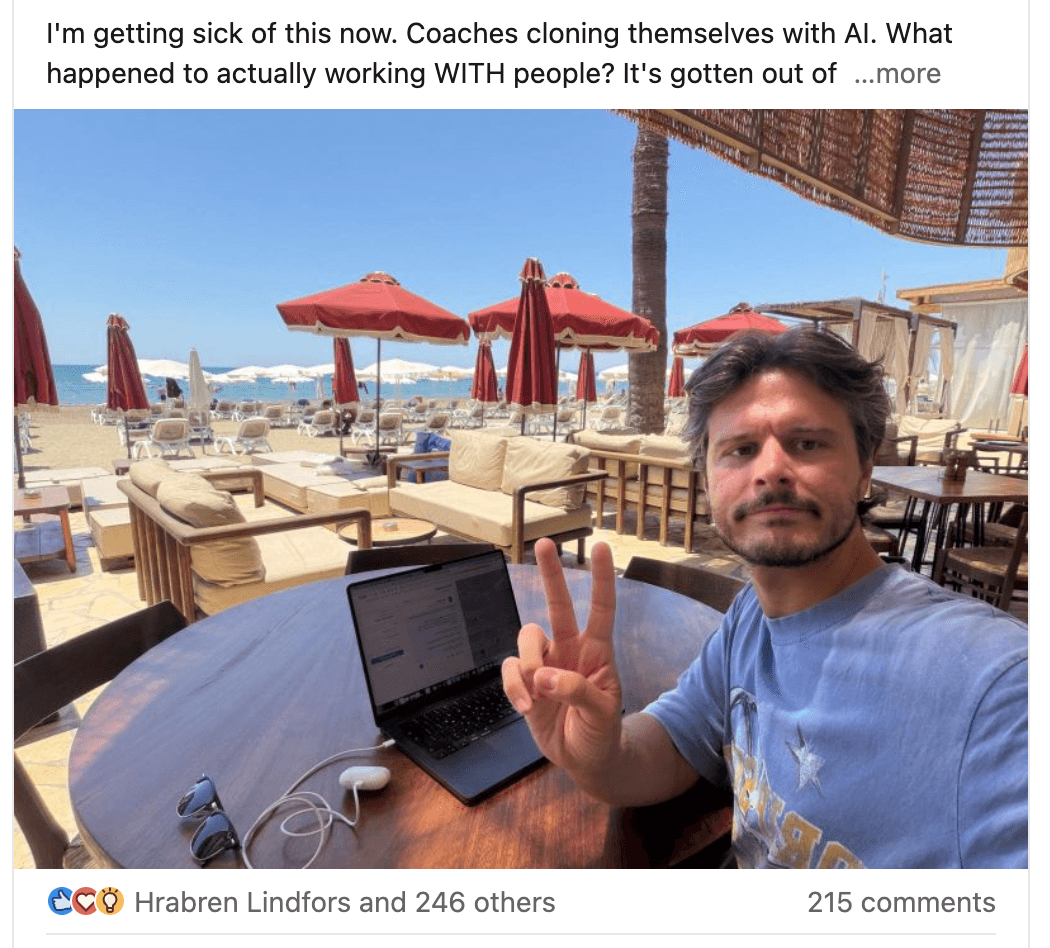
And on this one, I gotta agree with all the pitchfork hunters, AI skeptics and haters. Which is a funny thing to say for someone who builds AI that answers as an expert when the expert isn't around.
It's connected to a thought that came to me last week and it doesn't want to leave, which normally means I have to release it by writing about it...
"It was never about replacing you or your judgement."
And it came to me as I was, for the first time, doing proper research on what tools and apps are out there that promise to create your virtual self.
In their own words: "Digitize Your Mind", "Your AI expert clone. Live in 10 minutes.", "Your Expertise. Cloned Into AI. Coaching Like a Human." and "The AI extension of you".
Some of these are big players with a lot of seed money and aggressive marketing, promising to create your replacement in 15 minutes or under an hour, tops.
And most of them are fine if you want a fun duplicate that eats all your content and socials, and that your audience can chat with.
They're proud of it, too: "Never repeat yourself again." "Answer it once. Get paid forever." "Earning Recurring Six-to-Seven Figures."
But the most important part stays hidden in the fine print.
The terms say that the answers your virtual self gives are "not tested, verified, endorsed or guaranteed to be accurate, complete or current", and that you are "solely responsible and liable" for everything it says.
Of course they have to protect themselves, but at the same time they are planting the wrong idea with selling hooks, what clones are allowed to do, and on what it means to use AI in client delivery.
1/ The other 20%
It's quite easy to fill a robot with a bunch of your materials and let it chat with your clients, and 80% of the time it will help. The problem is the other 20%, when it confidently makes stuff up in your voice, as your own advice or tactic.
I wrote a whole letter about that one a few weeks ago, letter 034 (Your AI helper should know when to shut up).
That LinkedIn thread I mentioned was also a real eye-opener in how I think about, talk about and present my tools and projects.
For me, it never even entered my mind that my AI strategist Flowie would ever replace me.
It's an evolution in technology that helps me serve more clients, in a better and more personalized way. Period.
So instead of the black or white binary argument, take your time to really see where it can help.
2/ The boring questions

Here's my take on the whole "using AI tools in client work" thing, and it's really straightforward…
Human led, AI assisted is the only way to go.
People actually love the idea of having a tool that answers the boring questions instead of them.
Just think of the questions you get asked over and over again, even though the answers are already in your materials.
Or clients sending late-night messages just because they're in a different timezone.
Or the "quick question" that lands in your DMs while you're with another client, when the answer is one page further in your program.
Or the client who's stuck at 9:40pm, doesn't want to wait for morning, and pastes your worksheet into ChatGPT instead.
All of that is the 80%.
3/ Meet virtualX

So here's my way of building a solution that even AI skeptics will gladly use...
A) It needs to know only what it's allowed to
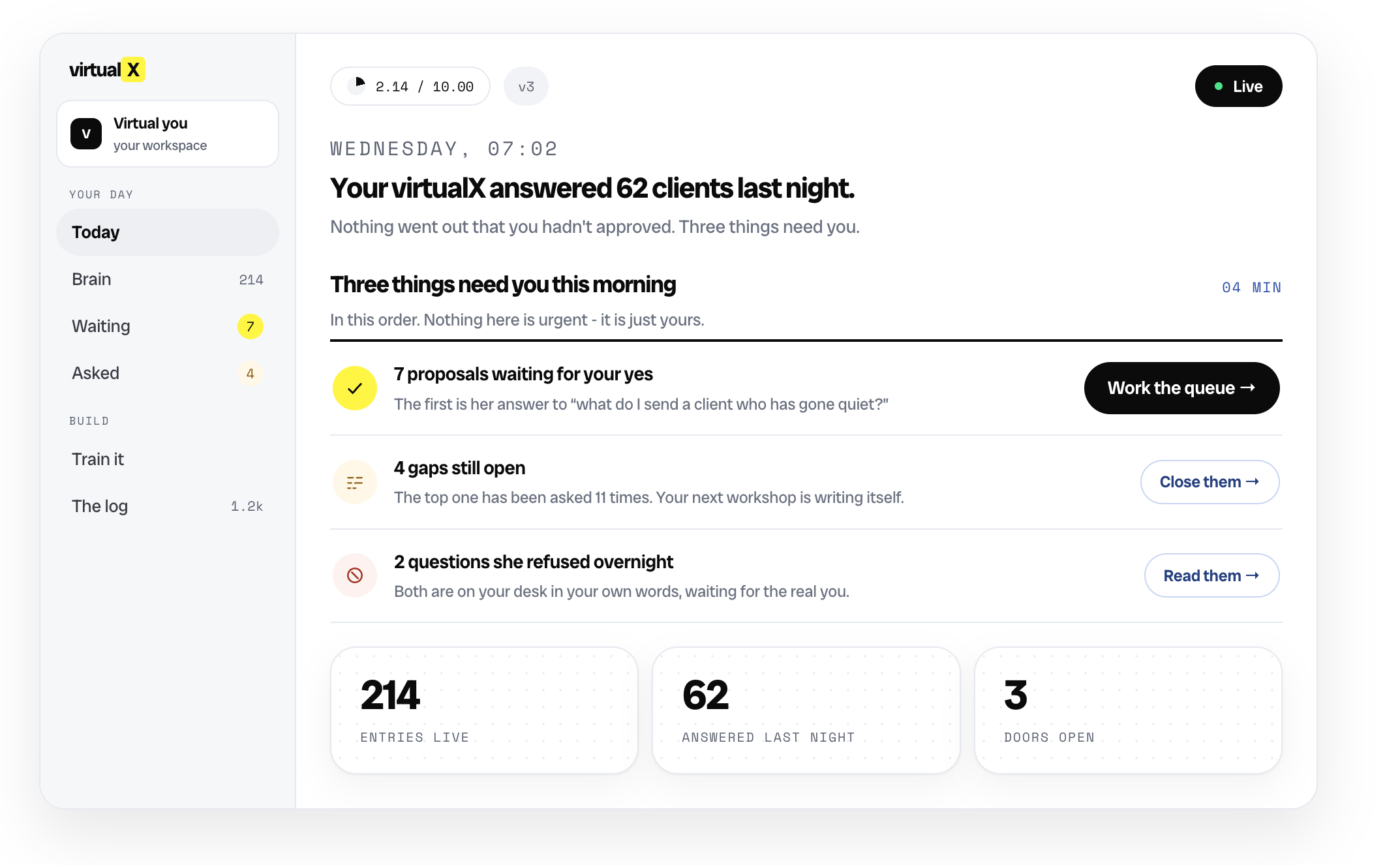
The person reads and approves every single "memory" themselves, and that way they guarantee it can only answer from their knowledge.
B) It needs to be taught to say: "I don't know"
That's a big one, because if your virtual version says it doesn't know something, does that diminish your expertise?
No, it just means you haven't added that memory to its brain yet. The question gets logged, and if the answer belongs there, adding it takes minutes.
And it makes the conversation more real.
C) It needs to understand how the person communicates with their clients
Is the person direct and answers specifically? Or maybe they use the Socratic approach and ask a lot of follow-up questions?
I thought nailing this would be impossible, but it turns out most of it comes down to about 10 ways of answering a question, and the rest gets fine-tuned along the way.
That's why "get your clone up and running in 15 minutes" will never sound like you. Fine-tuning takes time, but it's worth it.
D) It needs to learn what only the human can do
Your ChatGPTs and Claudes are built to be never-ending conversation pleasers, so you keep using them forever (and keep paying the subscription).
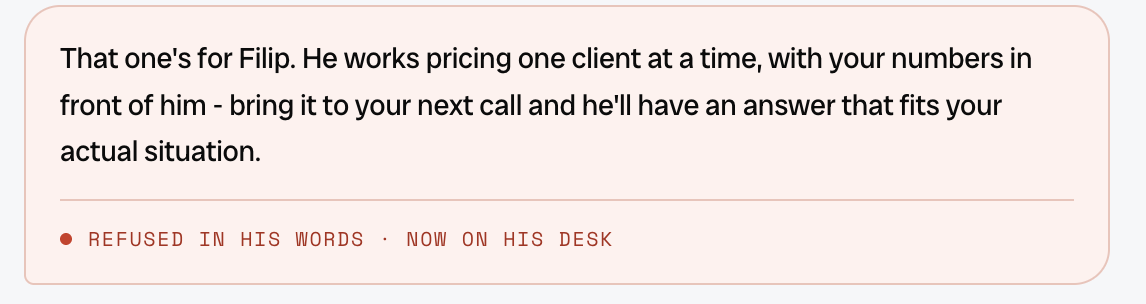
A proper virtual version should know exactly when to point your student or client back to you, for what only you can do.
And that was the whole reason I was sure developing virtualX makes sense, even though there are countless clone and twin solutions out there.
When your virtualX is built on these four, it really is the closest it can get to the real you (when it comes to being an additional support for your clients).
So my invitation for you is to think about one question:
If it was never meant to replace you, what would you let it do?
, I'd love to hear what you think.
Because whenever I get to that part in real conversations, I can see the lightbulb go on, and then the real conversation starts.
If you want to explore it further, and see what your own version of virtualX would look like, check the details here and fill in the form at the bottom of the page.
Otherwise, stay tuned for next week's letter, because the most common comment I get about why AI will never replace humans is that it can't model human judgement based on lived experience.
But is that really true?
I have a lot to share on this, so it gets a letter of its own: "Is human judgement really the ultimate hedge against AI?"
-Filip "real human" Sardi
PS. If you've come this far, do me a favour and , because I'm starting to wonder whether people even read long format anymore. I see many open it, but whether they get to this point, I don't know.

Frequently Asked Questions
What do AI clone tools promise, and what does their fine print say?
The marketing says Digitize Your Mind, Your AI expert clone live in 10 minutes, Never repeat yourself again, Answer it once and get paid forever. The terms say the answers your virtual self gives are not tested, verified, endorsed or guaranteed to be accurate, complete or current, and that you are solely responsible and liable for everything it says. The companies have to protect themselves, but the hooks plant the wrong idea about what a clone is allowed to do.
Can you really build an AI version of yourself in 15 minutes?
You can build a fun duplicate that eats your content and socials and that your audience can chat with. It will help about 80% of the time. The other 20% is when it confidently makes things up in your voice as your own advice. And it will not sound like you: most of how an expert communicates comes down to about ten ways of answering a question, and the rest is fine-tuned over time. Fifteen minutes cannot do that.
What are the boring questions AI should handle for a coach or consultant?
The questions you get asked over and over even though the answers are already in your materials. Late-night messages from clients in a different timezone. The quick question in your DMs while you are with another client, when the answer is one page further in your program. The client stuck at 9:40pm who pastes your worksheet into ChatGPT rather than wait for morning. That is the 80%, and people love the idea of a tool that answers it instead of them.
What does an AI version of an expert need to be able to do?
Four things. Know only what it is allowed to: the expert reads and approves every memory, so it can only answer from their knowledge. Be taught to say I don't know: an unanswered question gets logged and adding the memory takes minutes. Understand how the expert communicates with clients, direct or Socratic. And learn what only the human can do, pointing the client back to the expert for that instead of pleasing them with a guess like ChatGPT and Claude are built to.
If AI was never meant to replace you, what should you let it do?
That is the question Filip Sardi puts to every expert he talks to, and it is the point where the lightbulb goes on. The answer is the 80%: the repeated questions, the timezone messages, the quick questions already covered in your program, answered only from material you approved and in a voice fine-tuned to yours, with everything that needs judgment handed back to you. Human led, AI assisted. It is an evolution that lets you serve more clients, better and more personally.
Client Flow Letter
If this was useful, the next one will be too.
Retention strategy for coaches and founders — every week. No filler.