This very common "more value" trap showed up on a 1:1 call last week while we were reviewing a client's project work, her copy, and the plan for her public launch.
One of the big talking points was her competition, because she had just seen them put together a very similar offer.
Her competitor is doing a 2-day live event.
My client is selling a hybrid format - a mix of group sessions plus virtual support for 4 weeks.
And her immediate instinct was the same one I see for almost every founder in this season:
"What can we add to justify the price?"
More sessions. More bonuses. More support. More access.
Even though her pricing is already lower.
She wanted to:
- extend the timeframe
- maybe add another call
- definitely throw in extra materials
Not because her clients asked for it.
Simply because the 2-day live event "looked" more valuable in her body.
On top of that, her competitors are teaching one specific strategy, while my client is teaching her people the full framework that sits behind all of her work.
Meaning, her clients are getting way more return on their investments, both short and long term.
And we already have 15 people on the waitlist for the public launch round.
Cherry on the top? More than 30 clients have happily paid for the exact same hybrid format before (we filled up 4 beta groups over the past few months).
The data is there.
But the mind does what the mind does and it whispers one story on repeat:
"It's not enough. You are not giving enough. You are not worthy."
So my real job on that call was simple:
- remind her of the transformation she is actually leading people through
- remind her of the difference between "one tactic" and "full framework"
- remind her of the humans who already bought, implemented, and renewed
- remind her that when she gave even more access in the past - most people didn't need it
It took less than five minutes and her nervous system relaxed.
This is why I drew the line in letter 004 between access and presence - more access doesn't equal more retention.
If you've ever stared at your own offer and felt the urge to pack it with more, you know this place.
Let's talk about what's actually going on underneath.
1 of 7
What your clients are really paying for
Most founders secretly know this, but forget it when doubt hits...
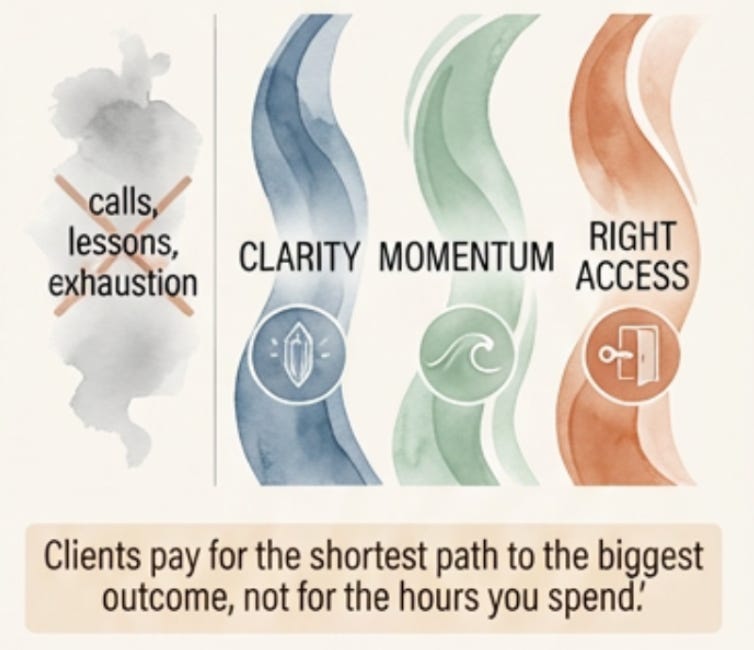
Your clients are not paying for:
- the number of calls on your calendar
- the number of lessons in your portal
- how exhausted you feel at the end of the week
In a high touch program, they are mostly paying for three things:
- Clarity - what to do, in what order, and what to ignore
- Momentum - a steady rhythm that carries them when their own motivation dips
- The right access at the right time - not 24/7 "ping me anytime", but a clear path to support while they are actually implementing
When those three are present, a lot of the extras we obsess over start to look heavy:
- extra calls no one shows up to
- replays that sit untouched in a library
- bonus modules that people feel guilty for never opening
You don't get a retention medal for how overwhelmed your clients feel.
If clarity, momentum and timed access are in place, you already have a strong backbone.
Everything else is optional.
Some of it is friction disguised as "value".
2 of 7
The "more for more" loop
There is a pattern I see even with experienced entrepreneurs and coaches.
It looks like this:
- Revenue feels unpredictable between launches
- A competitor rolls out something big and loud
- Your nervous system flips into "I'm behind"
- The brain's solution is: "Add more"
More calls.
More chat access.
More bonuses.
More "done with you".
More "I'll just throw this in as well..."
On paper, it looks generous.
In reality, it creates three predictable problems:
- You quietly teach your clients to lean on you for every small decision.
- Delivery gets heavier, so renewals feel risky for both of you.
- You burn margin, energy and creative space, which makes the offer hard to sustain when it actually works.
The painful irony?
The clients you want most, the ones who implement, think for themselves and respect your time - do not need all that stuff.
They need a clear structure.
They need your brain and presence at key moments.
They do not need ten extra hours of content and a WhatsApp hotline.
If you recognise yourself in this, it doesn't mean you don't know what you're doing.
It usually means:
- You care
- You're feeling the pressure
- Adding more feels safer than sitting with the discomfort
I still catch my own brain reaching for "more" when a launch feels emotionally loaded.
But the answer is almost never more weight.
It's more focus.
3 of 7
From carrying them to walking with them
There is one question I keep coming back to when I look at an offer:
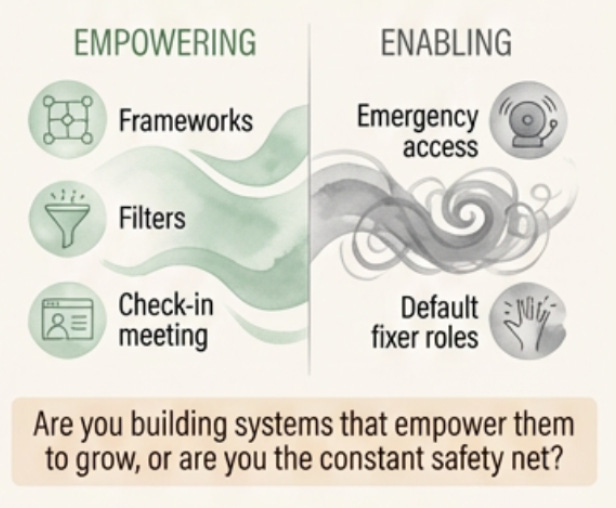
"Does this feature help my clients rely on themselves more, or rely on me more?"
If it only works when you are overfunctioning at 110 percent, it is probably not as valuable as you think.
Empowering your clients looks like:
- frameworks they can return to without you in the room
- decision filters they can use when you're not on the call
- check-in rhythms where they track their own progress, and you reflect back patterns and opportunities
Enabling them looks like:
- "emergency" access for anything mildly uncomfortable
- being the default fixer instead of a thinking partner
- saying yes to every extra call when you are tired but afraid to disappoint
Empowering value sounds like:
"I'm here as your partner, and I'm building structures that help you own your results."
Enabling value sounds like:
"I'll carry all of this for you, even if it drains me."
One of those creates strong renewals and referrals.
The other creates quiet resentment on both sides.
Your clients will never say "I resent you" out loud.
They will just drift, disengage, and not renew.
4 of 7
Are you even looking at the right signals?
When you're inside the "not enough" loop, you almost always zoom in on the wrong data.
You compare your landing page to someone else's.
You compare your price to their "limited time only" deal.
You compare your format to whatever is trending this month.
None of those tell you anything about the actual experience your clients are having with you.
Instead, try this:
- Do people come back for a second or third offer with you?
- Do they send friends and colleagues your way without being bribed?
- Do they stay engaged across your program milestones (Activate, Educate, Implement, Celebrate), or do they vanish quietly after week four?
- Do you get unprompted messages about shifts, wins and "this changed things for me"?
If the answer is "yes" to most of that, your problem is almost never "lack of value".
It might be:
- that you're not communicating the value clearly
- that your delivery is not structured in a way your nervous system trusts
- that looking at your price triggers your own money stories
All of that can be worked on.
Very different from: "I must double the number of calls because my competitor does a 2 day event."
5 of 7
If they feel like they wasted it, they won't renew
There is a quiet way overstuffed offers kill your retention.

Clients don't complain and they don't ask for a refund.
They just leave with a low-grade sense of failure.
The pattern goes like this:
They join → They are excited → They try to attend everything → Life happens → They fall behind → They feel ashamed...
By the time renewal comes up, the story in their head is not "this wasn't valuable".
It is:
"I didn't use it properly. I shouldn't spend again until I prove I can be disciplined."
They felt pressure, not progress.
On the other hand, when your program is focused:
- a clear scope
- fewer, stronger touchpoints
- obvious "next step" pathways
clients can say:
- "I finished the core journey."
- "I know where I am now."
- "I can see the next level of support if I want it."
That is when renewals feel natural and clean.
Not a rescue mission.
Not "maybe this time I'll finally use it properly".
So before you throw in another six bonuses, ask:
- Will this actually help my clients complete the core journey?
- Or am I making it harder for them to feel done and proud?
Your sustainable growth depends less on how impressive your bonus stack looks, and more on how simple it feels to win inside your world.
6 of 7
The nervous system check
One question I've started asking clients when we review their offer:
"Picture 15 or 30 people in this program at once. When you imagine delivering it, does your body tighten or relax?"
If your chest tightens, your jaw clenches, or you feel that "there is no way I could keep up with that" feeling - your offer is already too heavy.
Not in theory.
Not in the sales doc.
In your body.
And if your body doesn't trust your offer, your clients will pick that up in every sales conversation.
They might not know what they're feeling.
They will just sense that something in you is bracing.
If, on the other hand, you imagine that same group and feel:
- "I could do this week after week."
- "I know where they are in the journey at any moment."
- "I know how to support them without being on call 24/7."
Then your structure is probably aligned, even if your brain still whispers "add one more thing".
Your nervous system is a better advisor than your competitor's sales page.
Listen to it.
7 of 7
Let them feel the value that has been there all along
If you are reading this and feel that same urge to keep adding more to feel safe about your price, here is the invitation:
Before you bolt on another call or build another bonus, give yourself ten minutes with the questions in this letter.
And if you want a neutral pair of eyes on your offer, that is exactly what The Gameplan is built for - a 90-minute 1:1 retention diagnostic, a guided self-paced FlowOS diagnostic before the call, and a written 60-90 day action plan you can actually follow.
We look at your offer through the Three Blocks - Momentum, Founder, and Upgrade - strip away what is heavy, keep what actually moves the needle, and design a version your nervous system can trust.
So your clients can finally feel the value that has been there all along.
Until next week,
Filip "less is the offer" Sardi 🌊
PS. If your renewals are softer than they should be and you can't tell whether it's the offer, the delivery, or your own money stories - that's exactly what we untangle on The Gameplan call.

Frequently Asked Questions
Why does adding more value to a coaching offer hurt renewals?
Stuffing more calls, bonuses, and access into an offer usually creates overwhelm, not progress. Clients try to consume everything, fall behind, and leave with a quiet sense of failure. By renewal time the story in their head is 'I didn't use it properly,' and they don't re-up - even when the program was genuinely valuable.
What are clients in a high-touch program actually paying for?
Three things: clarity (what to do, in what order, and what to ignore), momentum (a steady rhythm that carries them when motivation dips), and the right access at the right time (not 24/7 availability, but support during real implementation). When those three are present, most of the extras founders pile on become friction disguised as value.
How do you know if your coaching offer is too heavy?
Run the nervous system check. Picture 15-30 people in your program at once and imagine delivering it. If your chest tightens, your jaw clenches, or you feel 'no way I could keep up' - your offer is too heavy. If your body relaxes and you feel 'I could do this week after week,' your structure is aligned. Your nervous system is a better advisor than a competitor's sales page.
How do you stop competing on bonuses and extras?
Stop comparing landing pages, prices, and formats. Look at the signals that actually predict retention: do clients come back for second offers, send referrals without being bribed, stay engaged across milestones, and send unprompted wins? If those answers are mostly yes, the problem isn't lack of value - it's communication, structure, or your own money stories. Adding more rarely fixes any of those.
What is the difference between empowering and enabling clients?
Empowering looks like frameworks they can return to without you, decision filters they can use when you're not on the call, and check-in rhythms where they track their own progress. Enabling looks like emergency access for anything mildly uncomfortable, being the default fixer instead of a thinking partner, and saying yes to every extra call when you're tired. One creates strong renewals. The other creates quiet resentment on both sides.
Client Flow Letter
If this was useful, the next one will be too.
Retention strategy for coaches and founders — every week. No filler.