
I've been quietly watching the AI conversation and trends unfold for some time now.
Trying to spot the moment where AI stops helping and starts distancing us from our clients, the very people we're here to serve.
Also, the moments where using it actually makes our programs and services more memorable for them.
And as someone who likes to observe the bigger picture before diving in, here's what I'm seeing clearly:
Yes, AI tools are getting smarter.
But, founders aren't necessarily getting clearer on how to use them.
Most are just trying to keep up with the next promise being peddled by the latest "AI expert."
So let's untangle this and answer a few questions that matter more than the tech itself:
- How do we keep human connection at the center of AI-powered systems?
- What should AI amplify in delivery and what should it never replace?
- And how do we keep our clients focus in a world built for more: more output, more automation, more noise?
1 of 5
The New Default
About a year ago, first came the panic:
"Coaches will be replaced. Fulfillment will be automated. Clients will talk to bots instead of mentors."
Then came the relief:
"AI won't replace you, it'll assist you."
And just like that, the race began.
Everyone started designing endless "custom prompts," inventing magical n8n automations, then building their own custom GPTs and now, "AI agents" (most commonly called "OS systems").
And while I agree this shift is inevitable and will give you a big advantage when done right, most people are sprinting faster than they're thinking.
We can all agree that client behavior is changing:
- They don't want ten-hour video courses
- They don't want static implementation materials
- They're more overwhelmed (social feeds + endless personal GPT threads).
- They feel more isolated (even though they chat all day with their favorite robot)
- They're getting used to chatting their way to answers - asking a question, getting instant feedback and moving on
- They're commoditizing the term "expert," since they can prompt their robot to be one on demand
The result?
The industry is shifting toward faster everything: faster learning, faster output, faster delivery, but not necessarily better results.
And it's not just in our space.
Earlier this year, my favorite Digital Contrarian, Ryan Levesque, shared in one of his weekly letters a surprising MIT study showing that 95% of enterprise AI pilots are failing.
Not because the tech doesn't work, but because companies are, in their words, "automating chaos".
That line stuck with me because I think it's exactly what's happening in our world too.
We're building faster programs and personalized AI layers, but if they're not connected to the rhythm of real client progress…
…we're just making disconnection look productive.
The question isn't whether to use AI.
It's how to use it without losing the heartbeat of your business.
And maybe that's what the new default should really be.
Not just creating more content and AI tools, but understanding what's actually happening underneath it all.
2 of 5
From boring data to supporting intuition
I've been proudly wearing a Whoop band for almost four years.

At first, it was all about tracking classical metrics like strain, recovery, HRV, sleep.
Being a numbers nerd, I loved checking data and noticing trends, but their predictions didn't always make sense.
Some days it would show green recovery, but I'd feel terrible.
Other days it would show yellow, yet I'd feel on top of the world.
Then they started adding context.
A daily journaling process where you could quickly log how your day looked: travel, alcohol, mood, stress, food…
They began tracking the details that don't show up in metrics, but shape what those metrics actually mean.
Now their system is getting smarter - not because it's producing more data, but because it's learning to connect it.
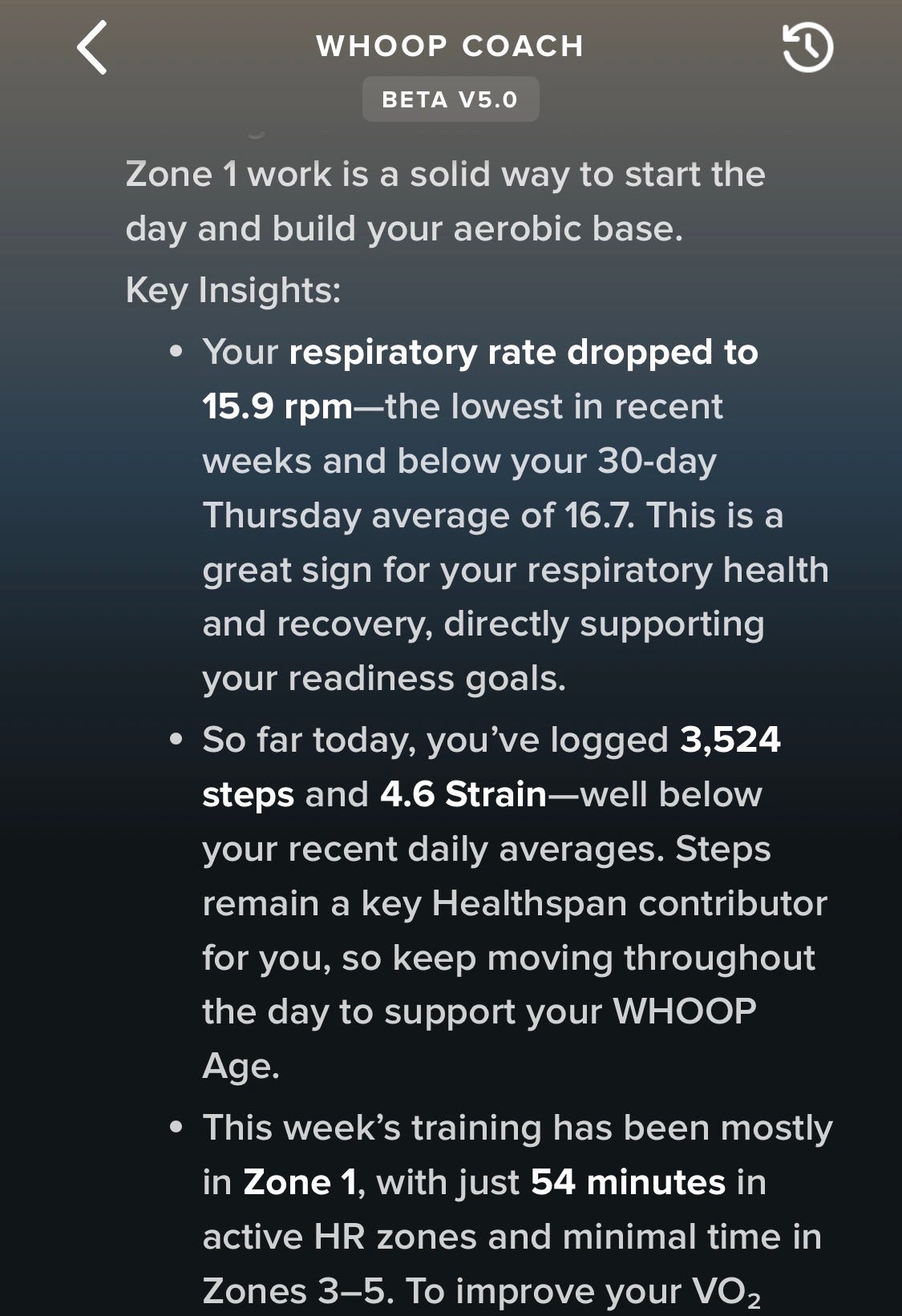
It considers your habits, goals, and patterns over time, then offers insights that feel closer to reality.
And of course, there's now your personal AI assistant.
The first version could barely analyze activity trends, but the current fifth iteration identifies habits, connects historical data, and references your goals to provide better context.
Their latest study, published in the peer-reviewed journal SLEEP, confirmed that context changes everything.
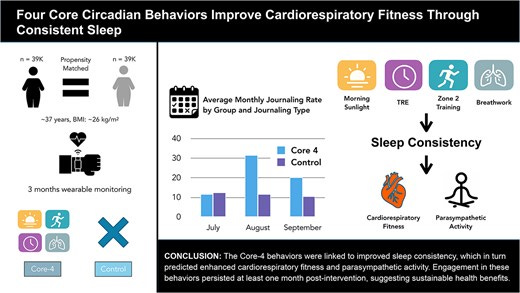
They tracked over 38,000 healthy adults across a 31-day challenge and found that four simple circadian-alignment behaviors led to measurable improvements in sleep regularity, resting heart rate, and HRV.
4 behaviors: morning sunlight exposure, time-restricted eating, Zone 2 training and daily breathwork
In other words, recovery didn't improve because people slept longer.
It improved because they aligned their habits with their data.
Adding behavioral context created stronger, more sustainable progress than metrics alone could predict.
Most founders think they know what's happening with their clients.
They can quote metrics, completion rates and call attendance.
But without context and without the human signals beneath the surface - you're reading a recovery score without understanding the day that led to it.
That's why I believe the next big AI role will be not to replace you, but support your intuition.
To show us what we might be missing and to help us respond before momentum fades.
3 of 5
New mentor's role: The Curator
Clients have started bringing their own robots to calls which are recording and immediately "learning" all your secrets on the fly.
Other than interpreting their dreams, and making travel plans, their favourite AI also knows your niche and it's studied your competitors.
And by the time they show up on your 1on1 or group call, it's handed them five "winning" strategies - all neatly summarized and perfectly logical.
The funny part is that machine is not wrong.
Most of those strategies work, just not all of them work for them.
That's where our role as mentors is evolving.
We've always guided and challenged our clients, but now we also curate.
We filter what's true for them from what's merely clever.
We help clients slow down long enough to choose what actually fits their current capacity and goals.
I used to get frustrated when a client would show up with a "winning" plan from ChatGPT, ready to pivot their whole business overnight.
Now, I smile.
Because I do similar thing with fitness plans and food protocols - trying to figure out the best possible option, and have at least 3-5 styles to choose from.
We all want the shortcut and the proof that someone already figured it out.
So instead of fighting it, I meet them there.
We look at the ideas together, test them against what's real, and nine times out of ten, they come back to the original plan.
Not because I convinced them, but because they could finally see the contrast between beautiful information and experienced advice.
I went deeper on the Curator role in letter 007 - what it actually changes inside Activate, Educate, Implement, Celebrate.
4 of 5
Beyond prompts: turning AI into real leverage
I feel that adding AI tools to is the way to go, so over the past few months, I've been testing tools from different experts and creators.
Some were just dressed-up GPTs embedded into a webpage to look sexy:
- "AI content systems" that generates out 30 posts in 30 seconds, but none sound like the your tone of voice
- "Course builders" that convert video transcripts into "AI-powered micro-lessons", but still feel like generic advice.
Like my friend Phil would say - most of that was a lot of beautiful nothingness.
One the flip side, I've tested properly designed AI systems, built around a clear methodology and designed to serve a specific stage of the client journey.
AI tool suite built around your offer design framework that doesn't just "generate copy," but coaches clients through key decisions - naming their promise, mapping the micro-wins and helps to define the outcome.
I broke down the MicroWins system in letter 012.
And once you have your offer, it helps write personalized email sequence and social posts built around your brand tone of voice.
Or an agent that reads call transcripts and flags client quotes that signal confusion or breakthrough (which is really helpful when you're handling a lot of live calls).
Or our internal beta tool (The Pulse) that helps clients reflect on progress every week, identifying emotional cues in their answers and giving you an early signal when momentum drops.
Yes, you will probably benefit from having an AI tool in your business, but don't rush just for the sake of having an "AI edge".
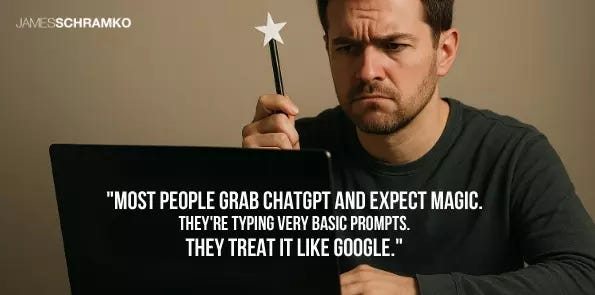
My OG mentor James Schramko explained this in depth on his podcast - Episode #1140 – Why AI Won't Save Your Broken Business Model
It's basically the evolution, from:
Manual prompts → workflows → operating systems → intelligent assistance.
At first, everyone plays with prompts.
You copy, paste, tweak, and feel like a magician for a moment.
Then you start connecting pieces - automations, SOPs, implementation steps…
That's when AI becomes a productivity tool.
But the real transformation begins when you build systems around your own frameworks.
When AI isn't just producing output, but supporting how your business actually delivers results.
That's when it stops being hype and starts becoming leverage.
REMEMBER: When your systems are designed around clarity and care, AI doesn't replace you.
It reflects you and your unique expertise.
5 of 5
The Human Rebound
That reflection is starting to create an unexpected shift in what clients want more of.
(surprise, surprise)
The louder the AI hype gets, the more people are craving something it can't replicate - empathy and human connection.
One of the biggest questions I discuss with my clients nowdays is:
"How can we make sure parts of our process stay personal?"
Don't get me wrong, they still value efficiency (and want the shiny AI toolset), but not at the cost of connection.
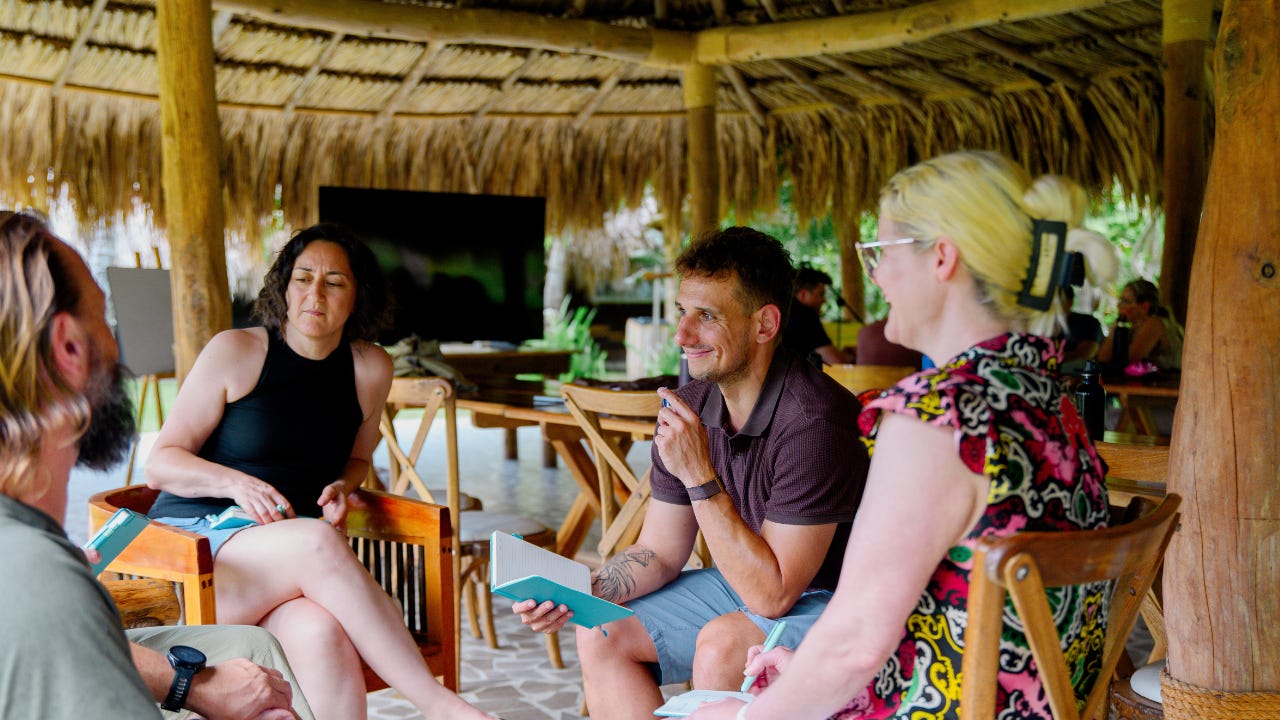
At a mastermind event in Colombia few months ago when talking about on how to build an AI-proof business, the biggest consensus of entire group was simple but powerful:
- Every business needs an offline component - live or hybrid experiences where people can feel you.
- It needs a community - a space where clients interact, share progress, and belong.
- And it needs high-end service - the layer where your expertise and lived experience outshine the hundred strategies a chatbot can produce in seconds.
My friend, and Medellin Mastermind host, Ron Reich said it well in his recent Facebook post (read it here):
"The coaching industry isn't collapsing - it's resetting."
The next cycle won't belong to the loudest funnels or the smartest automations.
It'll belong to the ones who managed to keep leading with empathy and care.
I don't want you to be remembered as someone who added more noise by chasing AI trends.
I'd rather see you among the few, the client-first mentors and founders who learned how to stay human while everything else became louder and easier to fake.
In the end, and even with all the advanced AI tools, technology doesn't replace integrity.
It reveals it.
It shows who's been building from care and who's been hiding behind the "beautiful nothingness".
That's why the real "boom" isn't the next AI feature.
It's knowing how to properly answer questions like…
Can people still sense you in the systems you build?
Can your clients feel cared for, even as things scale?
If this letter resonates, and you've been thinking about how to ethically include AI into your delivery while continuing to grow your business, The Gameplan is where we can map it out together - a 90-minute 1:1 retention diagnostic call, a guided self-paced FlowOS diagnostic to do beforehand, and a written 60-90 day action plan you can act on the next morning.
Until next week,
Filip Sardi 🌊
PS. If you'd rather start a conversation first, and tell me what part of your delivery you're trying to make more human (or more leveraged) - I read every reply.

Frequently Asked Questions
Will AI replace coaches and mentors?
No - but it will reveal who's been building from genuine care and who's been hiding behind surface-level work. AI handles strategies, scripts, and summaries instantly. What it can't replicate is empathy, contextual judgement, and the lived experience to know which of five 'winning' strategies actually fits a specific client right now. The mentors who survive this shift are the ones who lead with curation and human connection, not those racing to automate every layer of delivery.
How should coaches actually use AI in client delivery?
Stop chasing prompts and start building systems around your own frameworks. The progression goes: manual prompts to workflows to operating systems to intelligent assistance. Real leverage shows up when AI supports how your business already delivers results - reading call transcripts for breakthrough quotes, helping clients reflect on weekly progress, or coaching them through key decisions in your methodology - rather than producing generic output that sounds like every other coach in your niche.
What do clients still want from a human mentor in the AI era?
Three things AI can't fake: an offline component (live or hybrid experiences where they can feel you), a community where they belong and share progress, and high-end service where your lived expertise outshines the hundred clever strategies a chatbot produces in seconds. The louder the AI hype gets, the more clients crave empathy, contrast, and someone who can help them choose what actually fits their capacity - not just what looks logical on paper.
Why are most AI tools in coaching falling flat?
Because they automate chaos instead of clarity. An MIT study found 95% of enterprise AI pilots fail - not because the tech is broken, but because companies bolt it onto disconnected processes. The same is happening in coaching: dressed-up GPTs that generate 30 posts in 30 seconds with no voice, course builders that turn transcripts into generic micro-lessons. Without a clear methodology underneath, AI just makes disconnection look productive.
What's the new role of a mentor when clients show up with ChatGPT plans?
The Curator. Clients now bring AI-generated 'winning' strategies to every call - five neat ideas, all logical, most not right for them. The mentor's job is no longer to generate ideas. It's to filter what's true for that client from what's merely clever, slow them down long enough to test ideas against their real capacity, and help them see the contrast between beautiful information and experienced advice.
Client Flow Letter
If this was useful, the next one will be too.
Retention strategy for coaches and founders — every week. No filler.