I love it when a letter hits a nerve.
Last week I wrote about when the launch feels good but the pressure stays - because revenue keeps resetting instead of compounding. It resonated with more than a few of you, and it left me thinking:
If you could only focus on one action - the 4% that drives 96% - what single shift would actually move the needle the most?
My hypothesis: focus on figuring out and celebrating what I call MicroWins. Make progress visible. Give clients something tangible to point at every week. Stop waiting for the big transformation to prove value.
So I went full nerd mode and tested it. I fed the same questions into ChatGPT, Claude, Gemini, and Manus - hunting for patterns across 58 unique sources: benchmark reports, retention platform updates, SaaS studies, creator economy data, and the latest research on how organisations actually keep clients.
Five hours and one litre of coffee later, one theme was impossible to ignore. I started calling it Invisible Progress.
1 of 6
The Invisible Progress
Let's start with one totally unexpected discovery:
The issue isn't that they don't deliver value. It's that their clients can't feel it happening.
When I map client journeys with founders, here's what I notice: their clients show up to calls, consume content, feel busy, do the work. But when you ask them what changed this week, they pause.
The problem isn't that nothing happened - it's that they can't name it clearly. Progress is happening, but it has no shape. No consistent moments where they felt it land.
When progress becomes invisible, clients start to believe nothing is working - even when it is.
I wrote about the Customer Value Gap in letter 005 - the gap between the promise you make during the sales process and the value clients actually realise. Today, we address what causes that gap: Invisible Progress.
2 of 6
Retention Math
The research confirmed something I've been teaching from the start:
The first 30 days aren't about consuming your best material. They're about proving the decision to join was worth it. In the Flow Collective, we focus on even shorter timeframes - time to first client win under 72 hours, then 7 days, then 14 days.
This is retention math, not retention hope.
81% of organisations focus on client engagement, but only 43% find it easy to access or understand the data needed to monitor performance. About 39% have the data, but it's trapped across multiple tools.
So most coaches and founders wing it - flying blind, assuming what's happening, doing their best.
3 of 6
Three Ways Invisible Progress Shows Up in Delivery
Pattern 1: High engagement, no outcome visibility
Clients show up to calls, watch videos, engage in community. But there's no "pulse" on their progress. They can't name what changed this week, so it feels like busy work. Recent research shows lack of perceived ROI and lack of usage are now the top non-renewal drivers - even high engagement doesn't guarantee retention if clients can't connect effort to outcome.
Pattern 2: Content-heavy onboarding, no early wins
The first 7–10 days: seven videos, three worksheets, a welcome call. No milestone completion or emotional reward loop. Just information sprinkled with a welcome message.
Activation is not orientation. Activation is the most important momentum-building phase.
Pattern 3: Wins happen, but nobody's counting
Clients have small wins, but there's no reflection ritual. No moment where you mirror progress back to them. Their nervous system doesn't register the win, so it doesn't build commitment. Research highlights milestone wins as a key loyalty driver - but most programs don't design for this deliberately.
MicroWins celebration and reflection rituals are not "nice to have." That's retention engineering at its finest.
4 of 6
MicroWins Across the Journey
MicroWins aren't about hand-holding or dumbing down your program. They're about making progress tangible so clients can feel themselves moving.
Here's the structure we install inside The Flow Collective - not as theory, but as a working system:
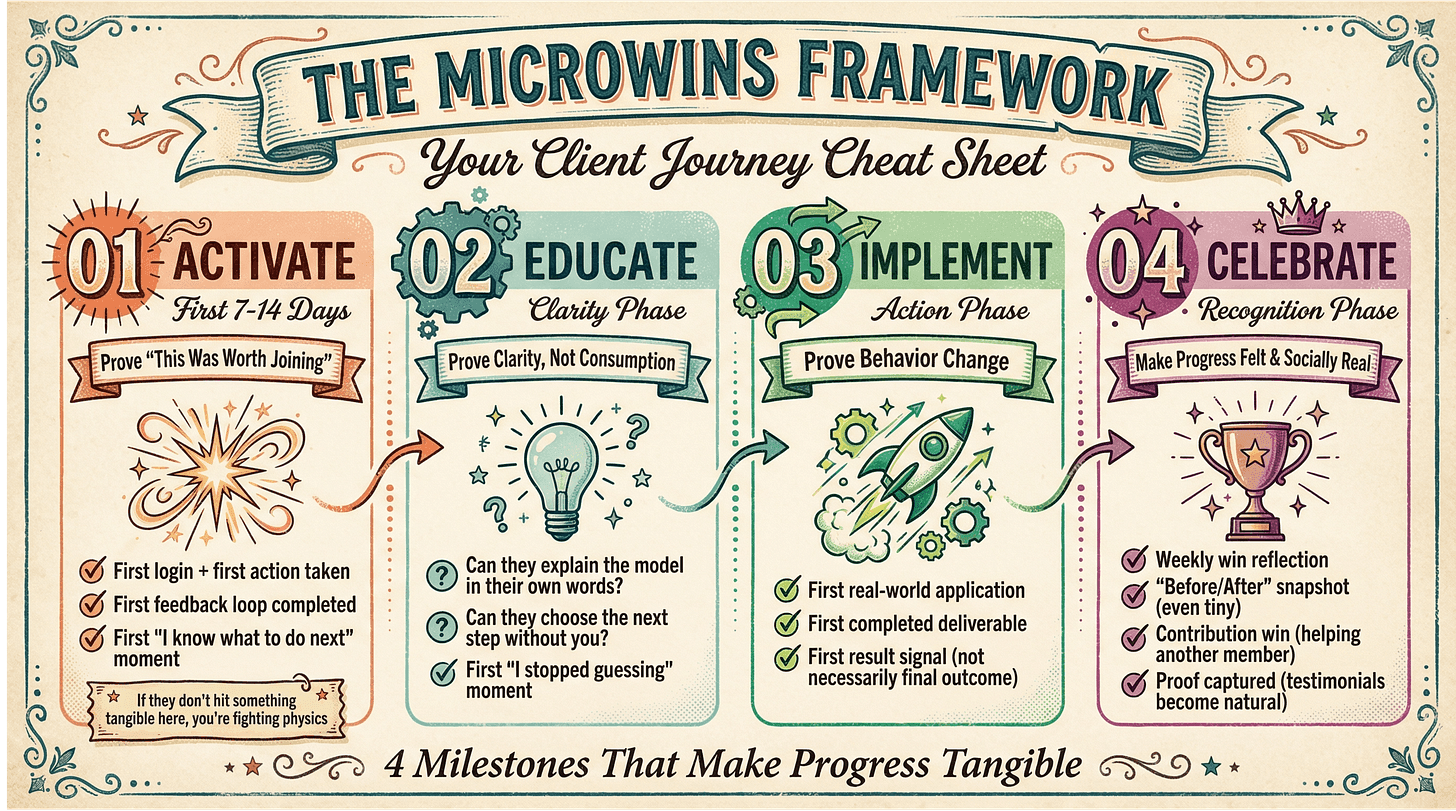
01 - Activate milestone (Days 1–14)
- First login + first action taken
- First feedback loop completed
- First "I know what to do next" moment
02 - Educate milestone
- Can they explain the model in their own words?
- Can they choose the next step without you?
- First "I stopped guessing" moment
03 - Implement milestone
- First real-world application
- First completed deliverable
- First result signal (not necessarily final outcome)
04 - Celebrate milestone
- Weekly win reflection
- "Before/After" snapshot (even tiny)
- Contribution win (helping another member)
- Proof captured - testimonials become natural
No MicroWins = no momentum signals. Which matches the reactive retention problem across every industry I researched.
5 of 6
The Part You Can't See (Until It's Too Late)
This is why I focus on tools like Client Flow Pulse - a simple weekly check-in that tracks how clients are actually feeling and moving, not just whether they showed up.
AI notices the patterns you'd miss: when someone's language shifts from excited to vague, when momentum stalls between milestones, when "I'm fine" actually means "I'm stuck."
But noticing isn't the same as understanding, and AI isn't a magic retention shortcut. Yes, the system flags the signal. But you're still the one who knows what it means and how to respond. That's the part that can't be automated.
6 of 6
Building for Momentum, Not Hoping for It
Advantage in 2026 belongs to founders and coaches who treat momentum as the system - not as something you hope for, but as something you design into every milestone.
The moat is no longer your content. It's your ability to show clients they're moving: through milestone tracking, visible wins, and systems that catch drift before it becomes churn.
Catching drift early is the post-sale responsibility I wrote about in letter 013 too.
The offers that last will be the ones where clients can prove - to themselves and to others - that momentum is real.
Until next week,
Filip "visible wins" Sardi 🌊

Frequently Asked Questions
Why do clients leave good coaching programs?
Clients most often leave not because the program is bad, but because they can't see their own progress. When progress is invisible - no clear milestones, no acknowledgment of wins - clients assume the program isn't working and disengage before results arrive.
What is the MicroWins Framework?
The MicroWins Framework is a four-milestone system for making client progress tangible: Activate (Days 1–14), Educate (clarity phase), Implement (action phase), and Celebrate (recognition phase). Each milestone proves a specific form of value so clients feel momentum instead of drift.
What percentage of coaching program clients churn due to invisible progress?
57% of founders report they cannot identify at-risk clients until it's too late, and 40% of clients who cancel say they 'didn't see results' - despite often making real progress that simply wasn't measured or surfaced.
How do you reduce churn in an online coaching program?
The most effective approach is to build structured progress milestones into your delivery: create early wins in the first 14 days, make outcomes visible throughout, and celebrate achievements so progress feels real - not invisible.
What is "invisible progress" in client delivery?
Invisible progress is real client transformation that goes unmeasured and unacknowledged. The client is growing, but neither the coach nor the client has a system to see it. It shows up as high engagement with no outcome visibility, heavy onboarding with no early wins, or genuine results nobody is tracking.
Client Flow Letter
If this was useful, the next one will be too.
Retention strategy for coaches and founders — every week. No filler.