
Authenticity matters and it always has.
It's what gets people to stop scrolling and to trust you enough to buy.
Especially now, when they're drowning in AI-generated noise.
But here's what authenticity doesn't do: guarantee they'll stay.
You can have the best positioning, the clearest brand, and content that feels unmistakably human.
And still lose clients in week three.
Think of it like this - after the sale, your client stops asking "Is this founder real?" and starts asking:
"Am I falling behind and pretending I'm fine?"
"Does anyone actually see me here?"
"What happens if I can't keep up?"
Most founders don't notice the shift so they keep solving a post-sale problem with pre-sale energy.
1 of 5The filter trap

I know what most people are thinking as the antidote to this:
"Fine. I'll just have better filters and get better clients."
If you only let in the disciplined ones: the doers, the low-drama high-output people, you won't have to worry about retention, right?
But (there's always one)…
Even your A-level clients are human.
They have weeks where their kid gets sick, months where a launch goes sideways, and quarters where life gets heavy and the thing that used to feel exciting suddenly feels like pressure.
And the more you rely on filters to protect your business, the more dependent you become on perfect conditions.
Because now your success requires always finding perfect people, instead of building an experience that helps real people keep moving when real life shows up.
Filters help, but they don't replace the work.
And here's the other common misconception that doesn't replace it: speed.
2 of 5The speed trap

There are many conversations happening right now about using AI to improve three things in delivery:
Speed - Implementation tasks that used to take your client two weeks gets done in three days.
Inputs - Instead of generic check-ins, you're asking "What stopped you from finishing this?" and actually capturing the answer.
Outputs - Instead of sending the same framework to everyone, each client gets their specific next three moves.
And all three are important, but here's what gets missed:
Faster execution doesn't help if the client is working on the wrong thing.
Better questions don't matter if you're not using the answers to guide what happens next.
And personalized outputs still feel generic if they don't account for what the client can actually handle this week.
Which is why founders who "automate everything" often end up babysitting the experience anyway.
Speed, inputs, and outputs improve motion. But motion isn't the same as progress.
I later named this the Implement-Block flip - the AI Speed Trap letter is the full breakdown.
And progress isn't the same as trust.
That's why staying relevant requires work in four different areas.
3 of 5The four post-sale responsibilities
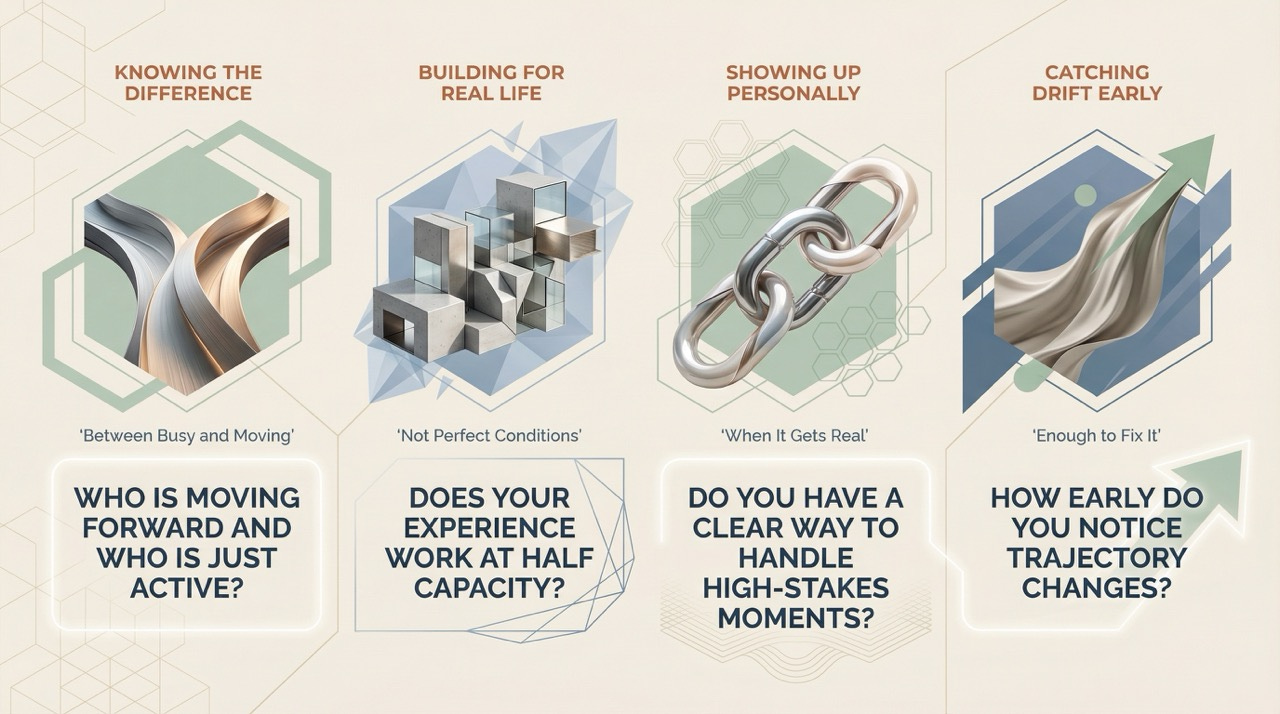
These four are the difference between a post-sale experience that runs on founder energy and one that runs on client trust:
#1: Knowing the difference between busy and moving
Activity can look healthy while momentum is slowly dying.
The real skill? Telling the difference between someone who's active but drifting and someone who's quiet but moving.
Those two clients need completely different support.
Most post-sale setups treat them the same.
And tracking basic client behavior isn't the same as tracking meaning underneath behavior.
If I asked you right now, "Who is moving forward and who is just active?" could you answer without guessing?
#2: Building for real life, not perfect conditions
Most post-sale experiences are designed for an imaginary client: unlimited time, perfect focus, stable life, clean weeks.
Real clients are managing constraints.
Relevance comes from designing around what they can actually carry without turning every dip in capacity into shame.
A brilliant plan that doesn't fit a real-life week becomes a quiet failure.
Does your post-sale experience still work when a good client has half their usual capacity for two weeks?
#3: Showing up personally when it gets real
There are moments where the relationship is being tested, whether you label them that way or not:
- a client admitting they didn't follow through
- a client wanting to downgrade
- a conflict in the community
- a hard boundary you need to hold
- a sensitive conversation that could go wrong if it's handled mechanically
AI can draft the right words.
But trust is earned in how those moments are held, especially when it would be easier to hide behind process.
This is where founders either protect the relationship, or ruin it.
When a client hits a high-stakes moment, do you have a clear way to handle it that increases trust or do you improvise every time?
#4: Catching drift early enough to fix it
Clients rarely need more information.
They need the course correction at the right time.
The same advice can unlock movement or create pressure, depending on when it lands.
Some clients need a push.
Some need simplification.
Others need a reset.
Relevance comes from noticing what the moment requires, early enough that it still changes the direction.
Most churn is just uncorrected trajectory.
The MicroWins system in letter 012 is how I make drift visible before it becomes churn.
How early do you notice a client's trajectory changing and what happens next?
4 of 5What I'm building next

I don't want Client Flow to become another brand that talks about delivery while secretly depending on founder energy to hold it together.
I want a post-sale experience that holds up even when I'm not "on".
Even when a client is messy, or when cohort energy dips.
Especially when life happens - like getting the flu few weeks ago and not being able to get out of the bed for a week.
That's the bar.
Which is why I'm not just writing about this - I'm building it live and showing you how it works.
And here's what makes this possible:
These four responsibilities can be translated into tools.
Not automation for the sake of it or "AI coach" vibes.
Tools that surface the signals and make the right interventions easier, without replacing judgment.
I'm not unpacking the tools here. That's FlowOS Lab territory.
But if you're reading this and can already feel which one of the 4 responsibilities is your current weak point, that's useful.
Because you don't need ten improvements.
You need one repair that changes the next 90 days.
5 of 5If one of these hit
You already know which one it is.
If you want to talk through what's happening in your post-sale experience and figure out the next move, that's exactly what The Gameplan is for - a 90-minute 1:1 retention diagnostic where we map your weakest of the four responsibilities, walk through a guided FlowOS diagnostic together, and leave you with a written 60-90 day action plan covering Momentum, Founder, and Upgrade.
Help you stay relevant after the sale - not by being louder, but by building something that works when you're not in the room all the time.
-Filip "building it live" Sardi

Frequently Asked Questions
Why does authenticity not guarantee client retention?
Authenticity is a pre-sale signal. It earns attention and trust enough for someone to buy. But after the sale, the client's questions change. They stop asking 'is this founder real?' and start asking 'am I falling behind?', 'does anyone see me here?', 'what happens if I can't keep up?'. Most founders keep solving a post-sale problem with pre-sale energy, which is why brilliant positioning still loses clients in week three.
Why are stricter client filters not enough to fix retention?
Filters help, but they don't replace the work. Even your best clients are human. They have weeks where their kid gets sick, months where a launch goes sideways, quarters where life gets heavy. The more you rely on filters to protect your business, the more dependent you become on perfect conditions. Real retention comes from building an experience that helps real people keep moving when real life shows up, not from screening harder.
What are the four post-sale responsibilities for client retention?
First, knowing the difference between busy and moving - distinguishing active drift from quiet progress. Second, building for real life, not perfect conditions - designing around constraints rather than ideal weeks. Third, showing up personally when it gets real - holding high-stakes moments without hiding behind process. Fourth, catching drift early enough to fix it - noticing trajectory changes while there's still time to course-correct.
Why does AI-driven speed not solve client retention?
Faster execution doesn't help if the client is working on the wrong thing. Better questions don't matter if you're not using the answers to guide what happens next. Personalized outputs still feel generic if they don't account for what the client can actually handle this week. Speed, inputs, and outputs improve motion. But motion isn't the same as progress. And progress isn't the same as trust.
How do you catch client churn before it happens?
Most churn is just uncorrected trajectory. Clients rarely need more information, they need the course correction at the right time. Some need a push, some need simplification, others need a reset. The same advice can unlock movement or create pressure depending on when it lands. Relevance comes from noticing what the moment requires, early enough that it still changes the direction.
Client Flow Letter
If this was useful, the next one will be too.
Retention strategy for coaches and founders — every week. No filler.